

In the bustling Ethereum landscape of 2026, dApp developers are rethinking wallet integrations as EIP-7702 matures into a cornerstone of account abstraction. No longer do users need to abandon cherished EOA addresses for smart wallets; instead, they can upgrade EOA to EIP-7702 delegates, blending legacy control with programmable perks like gas sponsorship and batch transactions. This EIP-7702 migration guide demystifies the process for you, drawing from real-world adoptions to ensure your apps stay competitive without forcing user migrations.
Picture this: a user connects their decade-old EOA to your DeFi dApp, and suddenly they enjoy session keys for one-click trades across chains. That's the promise realized since the Pectra hardfork in May 2025. As noted in Rhinestone docs, EIP-7702 equips EOAs with temporary smart contract code, preserving the same address while enabling advanced logic. Wallet providers like Uniswap have led the charge, defaulting new wallets to this setup, while offering upgrades for veterans.
EIP-7702 Mechanics: How Delegation Transforms EOAs
At its core, EIP-7702 introduces a new transaction type that lets an EOA specify delegate code during execution. Unlike full smart contract wallets, it doesn't overhaul storage initialization, as Safe Docs clarify; it focuses on code delegation. This means any wallet importing an EOA via private key or seed phrase, as Biconomy highlights, operates identically across interfaces, but now with superpowers.
For dApp builders, the workflow starts with user authorization. You prompt a signature authorizing your chosen wallet logic, then bundle it into a transaction that installs the delegate. Fluent docs outline this succinctly: select logic, get sig, deploy code. Boom, your user's EOA now batches swaps, sponsors gas, or enforces permissions, all without a new address. Alchemy's comparison of embedded EOAs versus traditional smart wallets underscores why this hybrid shines: familiarity meets flexibility.
This evolution sidesteps the friction of Ethereum-to-Aptos style migrations, keeping users rooted in their history. Yet, it's not magic; developers must pick robust delegate contracts, like those from Thirdweb's SDK, vetted for production.
Real-World Wins Driving 2026 Adoption
Uniswap Labs set the pace by shifting mobile and extension wallets to EIP-7702 delegation, per Etherspot insights. New users get smart features out-of-the-box; legacy ones upgrade optionally. Account Kit's integration, as Alchemy announced, turbocharges this with social logins and gasless flows, slashing onboarding barriers. Etherspot's multichain rollout on Ethereum, Optimism, and beyond enables chain abstraction, one sig for cross-L2 DeFi marathons.
These aren't hypotheticals. Zignuts Technolab pegs EIP-7702 as key to 2026 dApp UX, ditching seed phrases for social recovery and sessions. Turnkey's wallet basics reinforce that developers prioritizing speed and security lean into such abstractions. For your dApp, this translates to higher retention: users stick around when transactions feel native, not clunky.

I've seen teams at 7702migration. com accelerate integrations using our SDKs, cutting migration time from weeks to days. The payoff? Apps that feel future-proof amid Ethereum's push toward user-centric wallets.
Navigating Security Risks in EIP-7702 Upgrades
Enhancements come with caveats. OSL warns of phishing spikes exploiting batch approvals, malicious sites trick users into broad delegations. Nethermind details attack surfaces: poor delegate validation or unverified sigs can expose funds. My take? Prioritize audited logic and clear UI warnings; simulate transactions client-side before broadcast.
Start by auditing your dapp EIP-7702 integration. Use tools like our step-by-step guides to enforce nonce checks and permission scopes. Users must verify details meticulously, but your dApp sets the tone with transparent simulations. This balanced approach, power without peril, positions you as a trusted builder in 2026's Web3.
Delegates aren't one-size-fits-all; choose ones battle-tested for your use case, like Etherspot's for multichain or Account Kit's for embedded logins. This selective approach minimizes risks while unlocking account abstraction wallets that feel intuitive.
Hands-On EIP-7702 Delegation Setup for Dapps
Time to get tactical with your EIP-7702 delegation setup. The beauty lies in its simplicity: no address changes, just a signed authorization to inject code. Thirdweb's SDK streamlines this, letting you prompt users for a magic transaction that flips their EOA into a powerhouse. I've guided dozens of teams through this at 7702migration. com, and the common thread? Start small, test ruthlessly on testnets like Sepolia.
EIP-7702 EOA Upgrade Flow: Empower Your DApp in 3 Steps
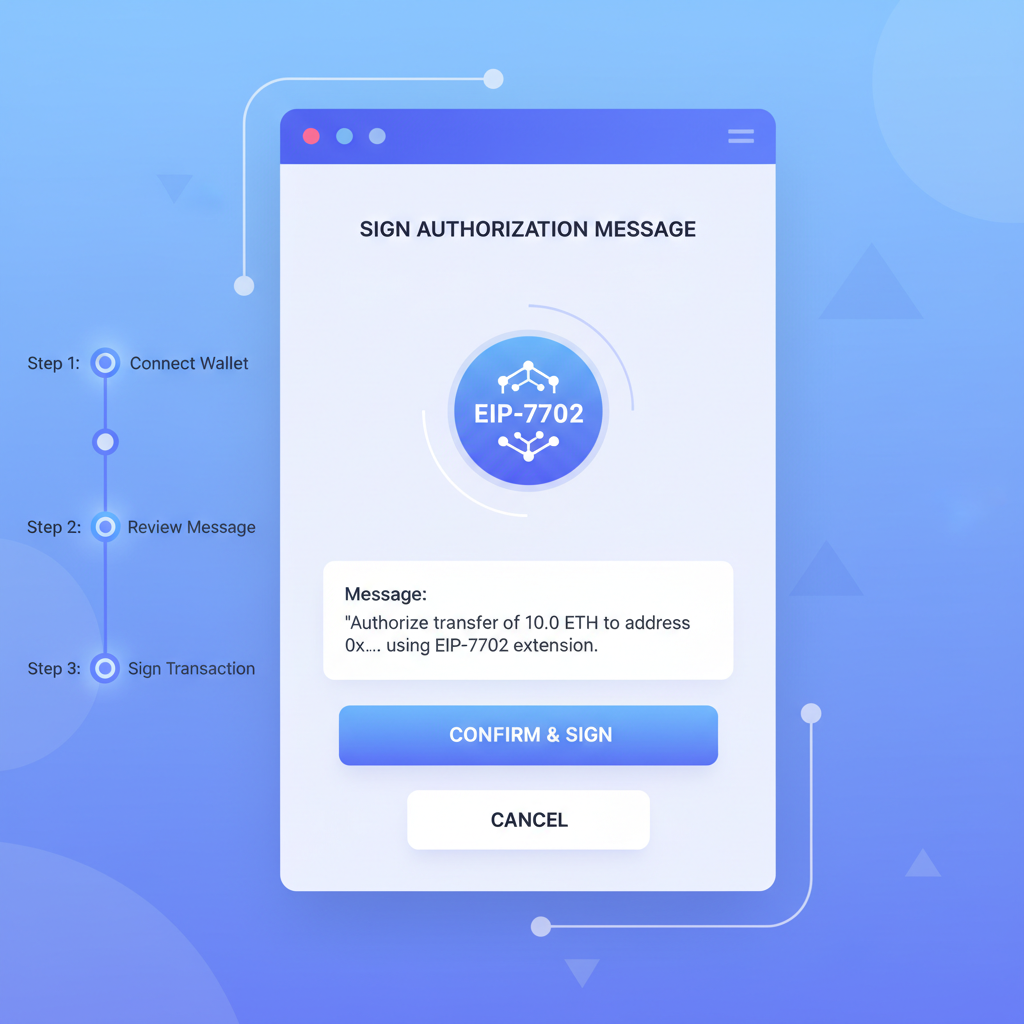
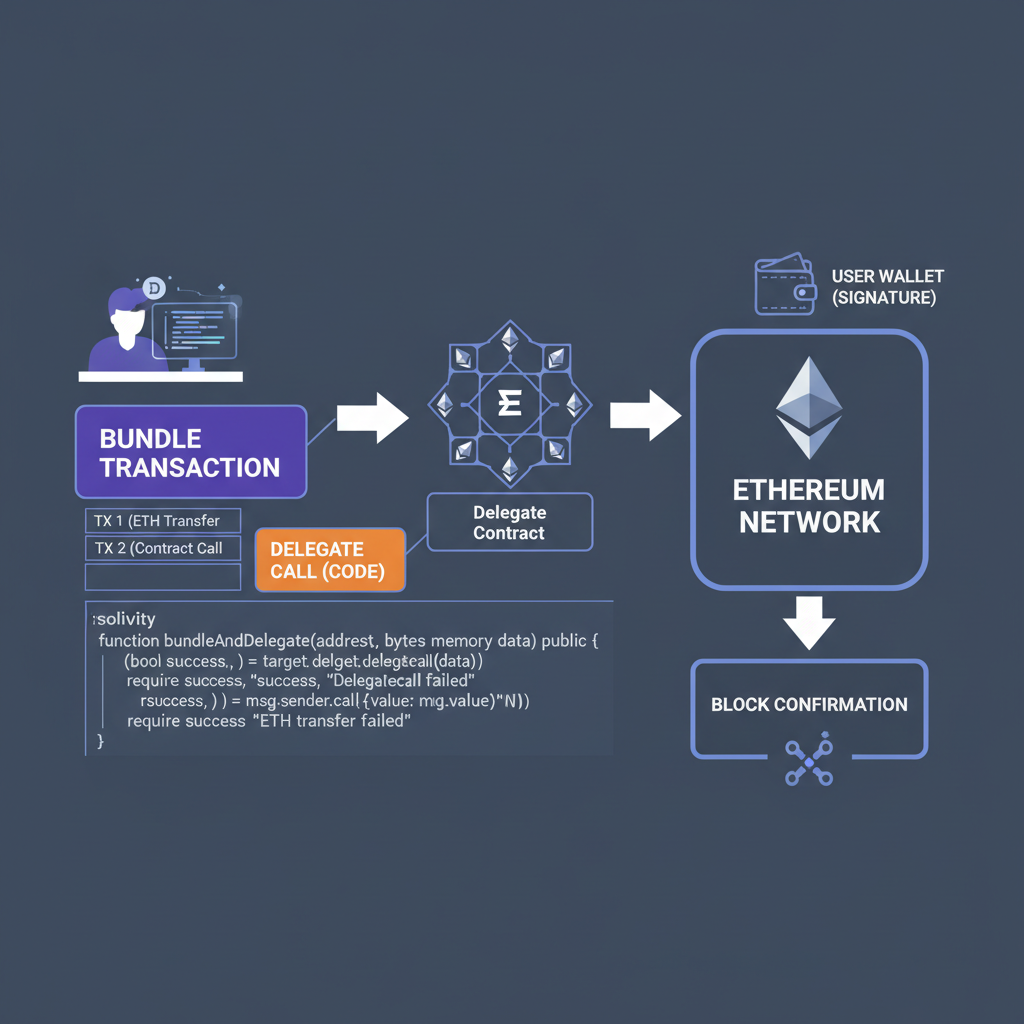

Once upgraded, your dApp taps into session keys for recurring actions or social recovery as backup. Zignaly's 2026 outlook nails it: this erases seed phrase friction, boosting conversion rates. But don't overlook L2 nuances; Etherspot's Optimism deployment shows how to abstract chains seamlessly, one signature ruling them all.
Code It Up: Practical Integration Snippet
Here's where theory meets terminal. Using ethers. js or viem, craft the delegation call. Focus on userSig from personal_sign, then setCode via the new tx type. Our SDK wraps this boilerplate, but peeking under the hood builds confidence.
Viem.js: Signing EIP-7702 Authorization and Sending Delegated Transaction
Upgrading EOAs with EIP-7702 delegation is elegantly simple using Viem.js. You sign an authorization to temporarily hand over control to a smart contract (like an ERC-4337 wallet), then include it in your transaction's 'code' field. This lets your EOA gain account abstraction features on-the-fly without a full migration. Here's a complete, working example—note the production caveats in comments.
import { createWalletClient, http, parseEther } from 'viem';
import { mainnet } from 'viem/chains';
import { privateKeyToAccount } from 'viem/accounts';

// For illustration only - in production, use a secure wallet connector (e.g., via Reown or Wagmi)
const account = privateKeyToAccount('0xYOUR_PRIVATE_KEY_HERE');
const walletClient = createWalletClient({
  account,
  chain: mainnet,
  transport: http('https://eth-mainnet.g.alchemy.com/v2/YOUR_API_KEY'),
});

// The smart contract address to delegate to (e.g., your ERC-4337 compatible wallet contract)
const delegateContractAddress = '0x1234567890123456789012345678901234567890';

// Step 1: Get user signature for authorization (handles nonce, chainId, etc. automatically)
const authorization = await walletClient.signAuthorization({
  contractAddress: delegateContractAddress,
});

// Step 2: Prepare and send transaction with delegation
// This tx will execute under the delegated contract's code

const hash = await walletClient.sendTransaction({
  to: '0xRecipientAddressHere',
  value: parseEther('0.001'),
  data: '0xdeadbeef', // Replace with your actual calldata
  code: [authorization],
});

console.log('Delegation tx hash:', hash);
This approach keeps things lightweight and secure, as the delegation is single-use per nonce. Pro tip: Always simulate the transaction first with `walletClient.simulateTransaction({ ... })` to catch issues early. By 2026, expect even tighter integrations with wallet SDKs like Reown for seamless user flows.
This snippet assumes a vetted delegate like Safe's core logic. Tweak for your stack, but always validate chainId and nonce to thwart replays. Deploying this in a React hook means users upgrade mid-session, no disconnects.
Tick these off, and you're golden. Nethermind's attack surface breakdown stresses nonce hygiene; skip it, and phishers pounce. Proactive auditing turns potential pitfalls into non-events.
Multichain Mastery and Future-Proofing
2026 isn't just Ethereum Mainnet; L2s dominate. Etherspot's Base and Arbitrum plans mean your Ethereum wallet migration 2026 spans ecosystems. Bridge users batch cross-rollup swaps under one approval, courtesy of chain abstraction. Pair this with gas sponsorship, and watch TVL climb as casual users join the fray.
Turnkey's wallet primer reminds us: tradeoffs matter. Pure EOAs lack programmability; full smart wallets demand migrations. EIP-7702 splits the difference, ideal for dApps chasing stickiness without overhauling UX. Alchemy's embedded EOA breakdown? Spot on for onchain games or socialfi, where speed trumps everything.
Real adopters like Uniswap prove the model scales. Their optional upgrades sidestep resistance, letting power users lead. For you, this means A/B testing upgrade prompts: 'Unlock batch trades?' converts better than walls of text.
Revocation is straightforward: sign a tx clearing the code slot. Most SDKs expose this as a one-click revert, preserving EOA purity if needed. Security-first dApps bundle revocation flows, earning trust in a post-phish world.
As Ethereum evolves, EIP-7702 cements EOAs as the on-ramp to abstraction. Ditch migration headaches; empower users to evolve in place. Grab our SDKs at 7702migration. com, follow these patterns, and build dApps that thrive through 2027 and beyond. Your users will thank you with loyalty that compounds.


No comments yet. Be the first to share your thoughts!