

As Ethereum's price holds steady at $2,330.82 with a 24-hour gain of and $13.22, wallet developers face a pivotal moment in 2026. EIP-7702 migration isn't just a technical upgrade; it's a momentum shift, turning static EOAs into dynamic smart accounts without address changes or fund migrations. Picture your wallet's transaction flow as a candlestick chart: EIP-7702 introduces a bullish engulfing pattern, where delegation code overrides EOA defaults, enabling batching, sponsorship, and permissions that propel user retention skyward.
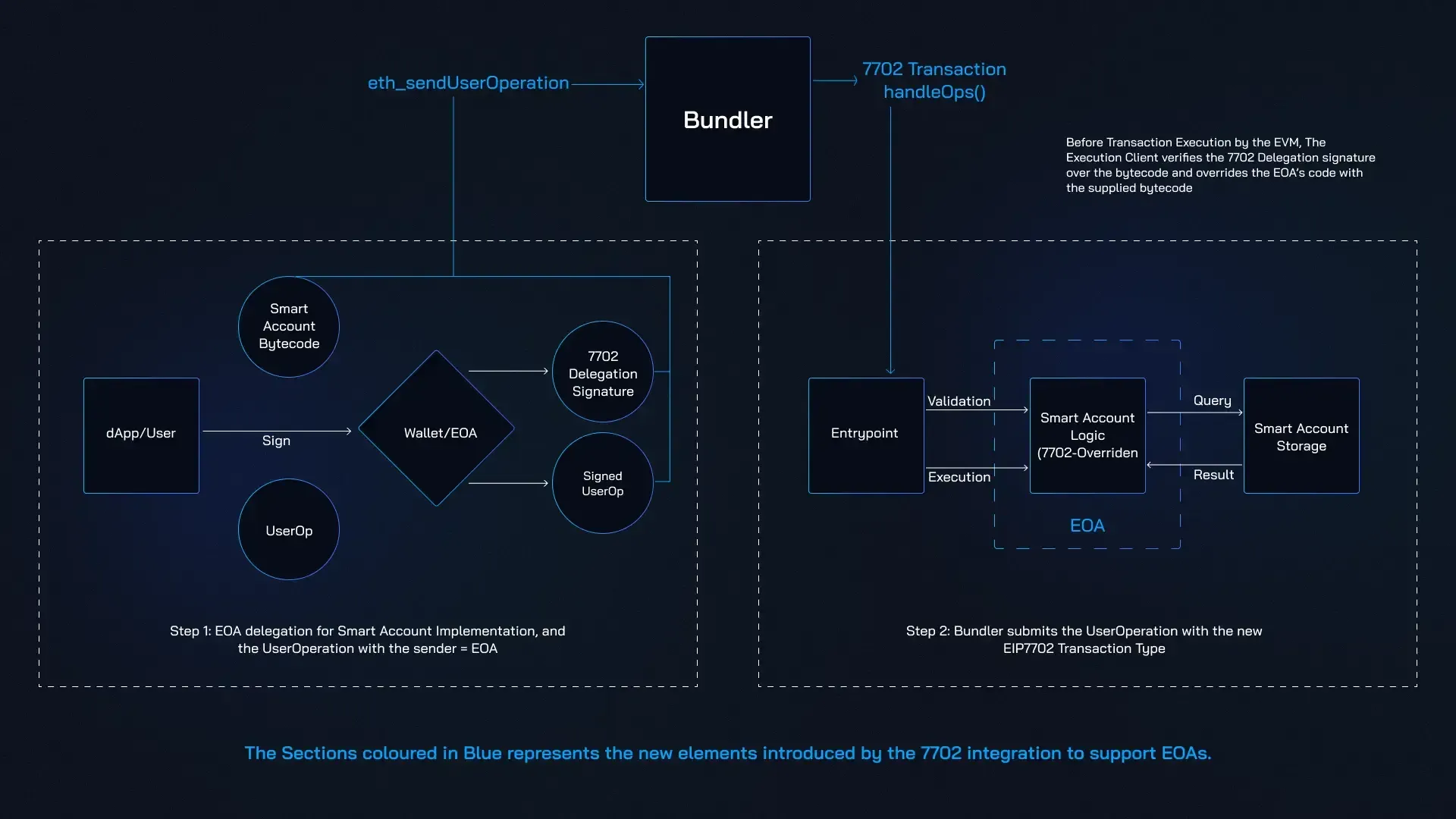
Envision EIP-7702 as a precise pivot point on the Ethereum execution chart. EOAs, once flatlines at zero code, now delegate to smart contracts via a new transaction type (0x04). This set-code transaction temporarily loads bytecode, letting plain accounts batch transfers or sponsor gas, all while keeping the familiar address. From my decade charting technical patterns, this mirrors a breakout above resistance: no funds move, yet functionality surges. Wallet SDKs like those from thirdweb, OKX, and our 7702migration. com toolkit capture this momentum, offering plug-and-play integration for dapps and providers.
Resources abound, from QuickNode's Foundry tests to Biconomy's app guides and ethereum. org's spec. But for wallet devs, the real edge lies in recognizing the delegation vector: sign once, execute complex logic. In a market where ETH's 24-hour high hit $2,332.58, ignoring this risks your users lagging behind smart wallet adopters.
EIP-7702 Smart Wallet Upgrade Demo with Viem
This JavaScript snippet using the Viem library showcases an EIP-7702 transaction. The EOA signs the transaction, but execution is delegated to the specified smart wallet contract via the `authorizationList`. This effectively 'upgrades' the account for this transaction.
```javascript
import { createWalletClient, http, parseEther } from 'viem';
import { mainnet } from 'viem/chains';
import { privateKeyToAccount } from 'viem/accounts';

const privateKey = '0xYOUR_PRIVATE_KEY'; // Replace with your private key
const smartWalletAddress = '0x1234567890123456789012345678901234567890'; // Smart wallet contract

const account = privateKeyToAccount(privateKey);
const client = createWalletClient({
  account,
  chain: mainnet,
  transport: http(),
});

const hash = await client.sendTransaction({
  account,
  to: '0xRecipientAddress', // Target for the transaction
  value: parseEther('0.001'), // ETH value
  authorizationList: [
    {
      contractAddress: smartWalletAddress,
      chainId: 1n,
    },
  ], // EIP-7702 authorization: delegates execution to smart wallet
});

console.log('Transaction hash:', hash);
```
Key elements: - `authorizationList`: Array of authorizations, each specifying a `contractAddress` and `chainId`. - The smart wallet contract receives control and can execute custom logic, such as bundling or validation. Broadcast this transaction to see the delegation in action on an EIP-7702-compatible node.
Essential Prerequisites: Charting Your Migration Readiness
Before diving into SDK setup, assess your wallet's baseline like scanning for support levels. Medium-risk plays demand solid foundations; skip this, and delegation bugs become your bearish reversal. Our EIP-7702 migration toolkit emphasizes efficiency, distilling complex evolutions into actionable checklists.
With Ethereum's low at $2,305.99 underscoring volatility, secure test environments first. Integrate security scans for phishing vectors in delegation auth, as noted in recent arXiv research. This setup positions your wallet for seamless account abstraction, future-proofing against Pectra upgrades.
SDK Setup: Step-by-Step Path to Activation
Installation kicks off the uptrend. Target wallet SDKs like thirdweb's EIP-7702 AA kit or OKX's js-wallet-sdk, but our toolkit at 7702migration. com streamlines with pre-audited contracts. Node. js 20 and, Hardhat or Foundry, and a RPC endpoint to Prague testnets form the backbone. Opinion: Skip bloated deps; viem's lean abstraction wins for production wallets.
Visualize the flow: EOA signs a 7702 tx with authorization list pointing to your smart code. No migration friction; users retain keys. Guides from Candide and HackerNoon validate this path, but our examples sharpen the precision.
Crafting Your First Set-Code Transaction
Hands-on momentum builds here. In JavaScript, viem handles the tx encoding effortlessly. Start with an EOA signer, craft the 0x04 tx including chain ID, nonce, maxFeePerGas, and the critical code field hex. Append magic bytes (0x01020304) for validity. This pattern recognition, spotting the code override, turns novices into pros.
That demand accelerates as developers spot the account abstraction migration inflection, much like ETH's recent bounce from $2,305.99. Now, verify your set-code tx lands clean, ensuring the EOA's code field updates without reverting. Foundry's cheatcodes shine here: vm. expectCodeChange simulates the pivot perfectly.
Verification Drills: Confirming Code Delegation Lands
Post-tx, query the account's code hash. Success patterns emerge when bytecode loads via the authorization list, overriding EOA defaults until nonce exhaustion. From OKX Wallet's js-sdk examples, this delegation persists across chains, a multi-timeframe bullish signal for cross-chain wallets. Our EIP-7702 migration toolkit bundles these tests, spotting weak spots before mainnet exposure.
Run it on Anvil: watch the trace light up as magic bytes validate. This precision mirrors chart confirmation candles, validating breakouts before scaling positions.
Batching Transactions: Multi-Action Momentum in One Sign
Batch ops form the core uptrend driver. EIP-7702 lets EOAs chain swaps, approvals, and transfers in a single sig, slashing gas and confirmations. Visualize it as a volume surge: one tx encodes user ops via EntryPoint, executed atomically. Thirdweb's SDK wraps this elegantly; pair it with paymasters for sponsored bliss. In 2026's Ethereum wallet upgrade race, this slashes drop-offs, boosting retention like a Fibonacci extension rally.
EIP-7702 vs ERC-4337 Comparison
| Aspect | EIP-7702 | ERC-4337 |
|---|---|---|
| Migration Ease | Seamless - No new account or fund movement needed 🚀 | Requires deploying new smart account and migrating funds 😩 |
| Address Change | None - EOAs retain original address ✅ | Typically yes - New smart account address ❌ |
| Gas Sponsorship | Supported natively via delegation 🌟 | Supported via Paymasters 🔄 |
| Batching Support | Full support for transaction batching ✅ | Full support via bundlers ✅ |
| Security Vectors | New delegation-based risks (phishing vectors ⚠️) | Mature but bundler/validator dependencies ⚠️ |
ERC-4337 demands new accounts; 7702 upgrades in place. Biconomy's guides prove it: delegate to a batcher contract, sign once, execute five ops. Code it lean with viem's walletClient. sendTransaction, packing ops into the code field.
Gas Sponsorship: Relayer-Free User Delight
Sponsorship pivots UX: dapps cover gas, users act fee-free. The delegation auth list points to a paymaster verifier, greenlighting txs. Trust Wallet's beginner guide charts this as efficiency gold; OKX implements it natively. Opinion: Prioritize on-ramp batches, where new users swap without ETH. ETH at $2,330.82 amplifies this, as high fees punish legacy wallets.
Test vectors from try-eip-7702 repo confirm: no reverts, full execution. This pattern scales to social recovery, permissions, turning wallets into momentum engines.
Fortifying Defenses: Phishing-Resistant Patterns
ArXiv flags delegation phishing: malicious code in auth lists. Counter with nonce pinning, sig validation, and UI warnings on code changes. Candide's quickstart stresses domain-bound delegates; enforce it. Our toolkit's security playbook scans for these, treating exploits as false breakouts to fade early.
Integrate with viem's simulateBundle; revert risky paths. QuickNode's Foundry drills expose edge cases, ensuring your wallet SDK EIP-7702 integration holds under volatility.
Mainnet Rollout: Live Migration Momentum
Prague testnets pave the path; monitor via 7702migration. com's dashboard mocks. Deploy logic once, let users opt-in via wallet UI toggles. Sei Docs' thirdweb guide scales this; adapt for your signer. With ETH's 24h high at $2,332.58, timing aligns: abstraction adopters capture the volume.
Users see seamless upgrades: swap history intact, keys unchanged. HackNoon code walks the full loop; refine it. This EIP-7702 wallet integration isn't optional; it's the breakout sustaining ETH's chart above key supports.
Wallet devs charting this migration see clear skies: efficiency compounds, users stick, and your app rides the abstraction wave. Deploy now, capture the momentum before the next leg up.


No comments yet. Be the first to share your thoughts!