
EIP-7702 activation and the 2026 landscape
EIP-7702 activated on Ethereum mainnet on May 7, 2025, as part of the Pectra hardfork. This upgrade introduced a fundamental shift in how externally owned accounts (EOAs) operate. For the first time, an EOA can temporarily set its own code, gaining the capabilities of a smart contract without changing addresses or requiring contract deployments [1].
The core mechanism is delegation. Instead of moving funds to a new smart wallet address, users can sign a transaction that authorizes a smart contract to execute on their behalf for a specific session. This allows EOAs to sponsor transactions, enforce spending limits, or batch operations, effectively blurring the line between simple wallets and smart contract accounts [2].
The term "migration" in 2026 refers to the adoption of this new tooling, not a movement of assets. Your ETH and tokens remain in the same address. The change is purely functional: your account can now run code. This distinction is critical for understanding the security model. While convenient, delegation introduces phishing risks if users unknowingly authorize malicious contracts to control their assets [3].
To understand the market context of this upgrade, consider the price action around the Pectra activation.
[1] https://ethereum.org/roadmap/pectra/7702/ [2] https://eco.com/support/en/articles/15254037-erc-7702-deep-dive-2026-eoa-becomes-smart-wallet [3] https://ethereum.org/roadmap/pectra/7702/
EIP-7702 vs ERC-4337: architecture choices that change the plan
The Ethereum account abstraction landscape splits into two distinct paths: upgrading the existing Externally Owned Account (EOA) or deploying a new Smart Contract Account (SCA). EIP-7702, activated in the Pectra upgrade, allows existing EOAs to temporarily delegate execution to smart contracts. ERC-4337, conversely, requires users to deploy a dedicated contract account from scratch.
EIP-7702 changes the fundamental nature of the EOA by allowing it to hold code. This means your existing address can gain smart contract capabilities without migration. ERC-4337 keeps the EOA simple and pushes complexity into a separate contract. This architectural difference dictates gas costs, deployment friction, and security models.
| Feature | EIP-7702 (Upgraded EOA) | ERC-4337 (Smart Contract Account) |
|---|---|---|
| Address Continuity | Retains existing EOA address | Requires new contract address |
| Deployment Cost | Zero (Type 4 tx only) | High (contract creation + funding) |
| Security Model | Delegated execution (reversible) | Permanent contract logic |
| Bundler Dependency | Optional (native support) | Mandatory (UserOperations) |
| Interoperability | Native EVM compatibility | Requires ERC-4337 bundlers |
EIP-7702 lowers the barrier to entry by eliminating the initial deployment cost. Users simply sign a delegation transaction to attach smart wallet logic to their existing key. ERC-4337 demands a more complex onboarding flow: deploying the contract, funding it for gas, and learning a new address. However, ERC-4337 offers more permanent, immutable logic that cannot be accidentally revoked or overridden by the user's private key alone.
The two standards are not mutually exclusive. An EIP-7702 upgraded EOA can plug directly into ERC-4337 bundlers and paymasters. This hybrid approach lets users retain their legacy addresses while accessing the sponsorship and session key features of account abstraction. For most 2026 migrations, EIP-7702 provides the path of least resistance, preserving address continuity while unlocking smart wallet functionality.
Smart contract optimization for enterprise wallets
EIP-7702 allows enterprises to optimize smart contract infrastructure without forcing users to migrate to new addresses. By delegating execution logic from an Externally Owned Account (EOA) to a smart contract, businesses can implement session keys and gas abstraction directly on existing wallets. This approach reduces the friction of onboarding while maintaining the security and simplicity of standard Ethereum accounts.
Session keys and automated operations
Session keys provide a powerful mechanism for automating repetitive tasks without exposing the master private key. Under EIP-7702, an enterprise wallet can delegate specific permissions to a smart contract for a limited duration. This allows for automated batched transactions, such as payroll distribution or liquidity rebalancing, without requiring manual signature approval for every single operation. The delegation remains revocable, ensuring that if a session key is compromised, the damage is contained to the specific scope and time window defined by the contract.
Gas abstraction and user experience
Gas abstraction transforms how enterprises manage transaction costs. By linking an EOA to a smart contract, businesses can sponsor gas fees for their users or internal systems. This means end-users can interact with dApps using their preferred tokens, while the enterprise covers the network fees in ETH. This capability is particularly valuable for B2B applications where seamless user experience is critical, as it removes the need for users to hold native tokens for every interaction. The optimization lies in the ability to batch these sponsored transactions efficiently, reducing overall network congestion and cost per operation.
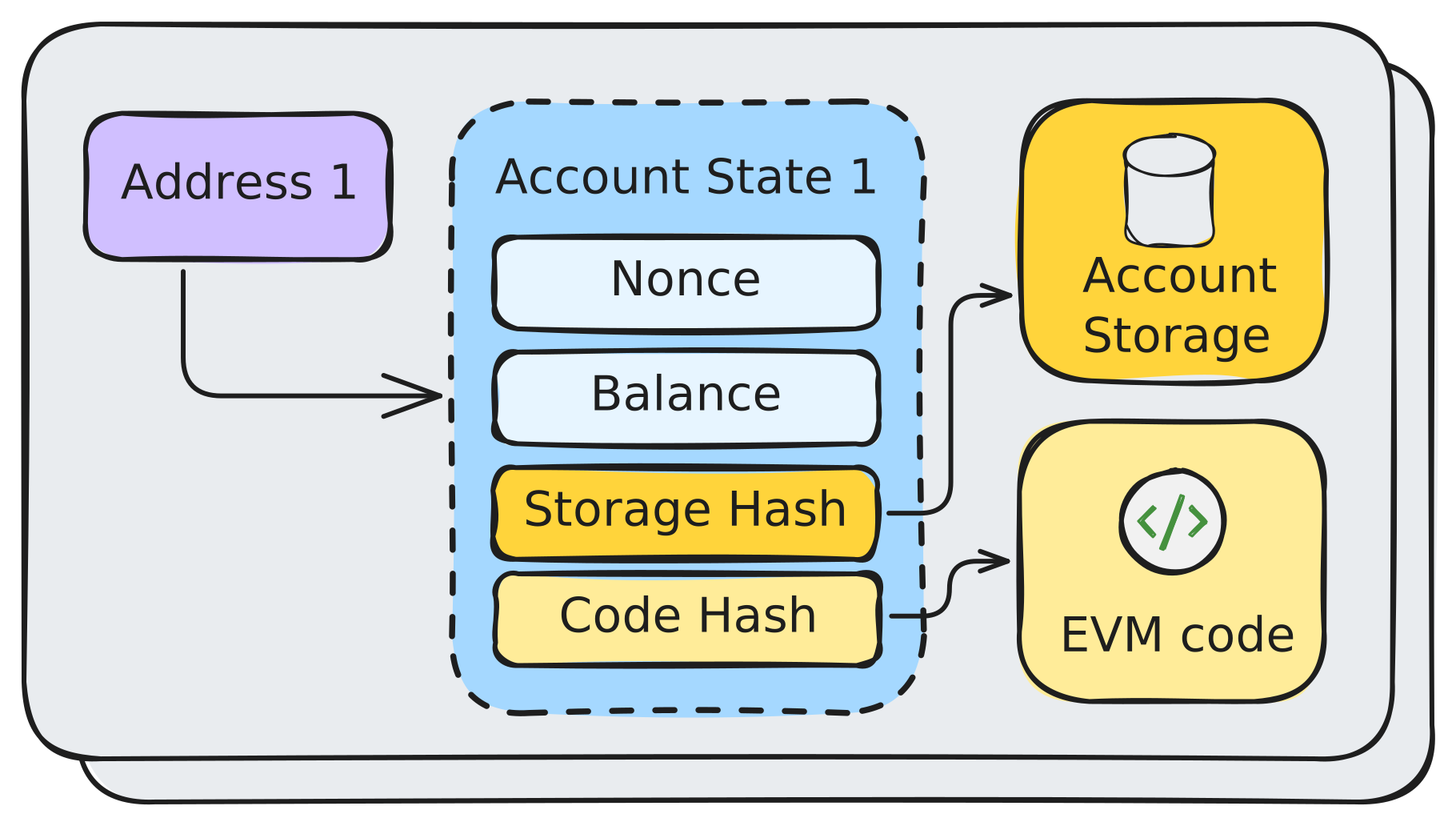
Blockchain scalability 2026 implications
As blockchain scalability strategies focus on reducing layer-two overhead and optimizing mainnet usage, EIP-7702 offers a unique advantage. It allows enterprises to implement complex logic on-chain without the deployment costs and complexity of full smart contract accounts. This flexibility supports higher throughput for enterprise-grade applications, as the optimized execution paths reduce the computational load per transaction. The result is a more scalable infrastructure that can handle increased volume without compromising on security or user convenience.
Security risks and delegation limits
EIP-7702 introduces a high-stakes security model: delegation is temporary and fully revocable, but the window for error is unforgiving. When you sign a Type 4 transaction, you are granting a smart contract temporary execution authority over your EOA. If that contract is malicious, the attacker gains immediate control over your assets. Unlike traditional smart contract interactions where you might interact with a known protocol, a compromised delegation can drain your account before you realize what happened.
The primary vector for this risk is phishing. Attackers may trick users into signing seemingly benign transactions that actually contain malicious delegation code. Because the transaction looks like a standard signature, users often overlook the underlying code injection. Once delegated, the attacker can execute arbitrary calls on your behalf. The revocability of this delegation is your safety net, but it requires proactive action. You must be able to revoke the delegation to restore control, which means your wallet must support the necessary transaction types.
Hardware wallet support is critical for mitigating these risks. Not all wallets display the full complexity of Type 4 transactions clearly. If your hardware wallet does not properly decode and display the delegation details, you are signing blindly. This lack of visibility turns a powerful upgrade into a significant liability. Always ensure your hardware wallet firmware is updated to handle EIP-7702 transactions transparently, so you can verify exactly which contract you are delegating to.
While EIP-7702 enhances functionality, it shifts the burden of security back to the user. The elegance of not changing addresses comes with the complexity of managing temporary code execution. Stay vigilant, verify every signature, and rely on hardware wallets that prioritize clear transaction decoding.
Enterprise adoption checklist for 2026
EIP-7702 activated on Ethereum mainnet on May 7, 2025, as part of the Pectra hardfork. It is the most consequential change to the Ethereum account model in years. Every existing EOA can now temporarily set its own code, gaining the capabilities of a smart contract without changing addresses. For enterprise teams, this means upgrading legacy wallets without forcing users to migrate funds or learn new interfaces.
The primary benefit is seamless integration with ERC-4337 bundlers and paymasters. Your EOAs can now sponsor transactions and enforce session keys while retaining their original addresses. However, this power introduces new phishing risks. If a user unknowingly delegates their account to a malicious contract, an attacker could easily gain control and steal funds. Your integration must prioritize security verification.
Follow this step-by-step guide to integrate EIP-7702 support safely.
Identify all EOAs currently in use. Determine which accounts need smart contract capabilities like session keys or sponsored transactions. Map out which legacy systems will break if the account model changes. This audit prevents unexpected failures during the upgrade.
EIP-7702 requires explicit user consent to delegate execution rights. Update your wallet interface to clearly display which contract will receive delegation. Ensure users sign a specific authorization transaction. Never automate this process without explicit, informed consent to prevent phishing attacks.
Verify that your upgraded EOAs can interact with ERC-4337 infrastructure. Test gas sponsorship flows and session key restrictions. Ensure that the temporary code execution does not interfere with standard transaction signing. Use testnets to simulate mainnet conditions before deployment.
Launch the update with a clear rollback strategy. Monitor for any unexpected behavior in delegation revocation. Ensure that users can revoke access to delegated contracts easily. Maintain strict logging to track all delegation events for security audits.
Technical Overview
The shift from simple key-based accounts to code-enabled EOAs changes how you build for Ethereum. You no longer need to deploy new contracts for every user. Instead, you can upgrade existing wallets to support advanced features.
This approach reduces friction for users while giving developers more control. By following these steps, you can adopt EIP-7702 without breaking your existing UX. The result is a more flexible, secure, and user-friendly wallet experience.
Frequently asked questions about EIP-7702
Is EIP-7702 implemented?
EIP-7702 activated on Ethereum mainnet on May 7, 2025, as part of the Pectra hardfork. It is the most consequential change to the Ethereum account model in years: every existing EOA can now temporarily set its own code, gaining the capabilities of a smart contract without changing addresses.
What new capability does EIP-7702 give to an EOA?
EIP-7702 introduces a fundamental shift in how externally owned accounts operate on Ethereum. By enabling code execution on EOAs, it blurs the line between simple wallets and smart contract accounts, all without changing user addresses or requiring contract deployments. An EOA upgraded via 7702 can plug directly into ERC-4337 bundlers and paymasters with no address migration.
What is the difference between EIP-4337 and EIP-7702?
EIP-4337 deploys a separate smart-account contract that holds funds and processes UserOperations through a dedicated mempool. EIP-7702 lets an existing externally owned account temporarily delegate execution to a contract without redeploying. The two are not mutually exclusive; they work together to modernize account abstraction.
What are the risks of EIP-7702?
Phishing risks increase with the implementation of EIP-7702 delegation. Because the assets in a user's account may be entirely controlled by smart contracts, if a user unknowingly delegates their account to a malicious contract, an attacker could easily gain control and steal funds. Users must carefully review delegation permissions before signing transactions.
No comments yet. Be the first to share your thoughts!