
EIP-7702 activates smart EOAs
EIP-7702 went live on Ethereum mainnet on May 7, 2025, as part of the Pectra hardfork. This upgrade introduced the most significant change to the Ethereum account model in years: Externally Owned Accounts (EOAs) can now temporarily delegate execution to smart contracts without changing their addresses [1].
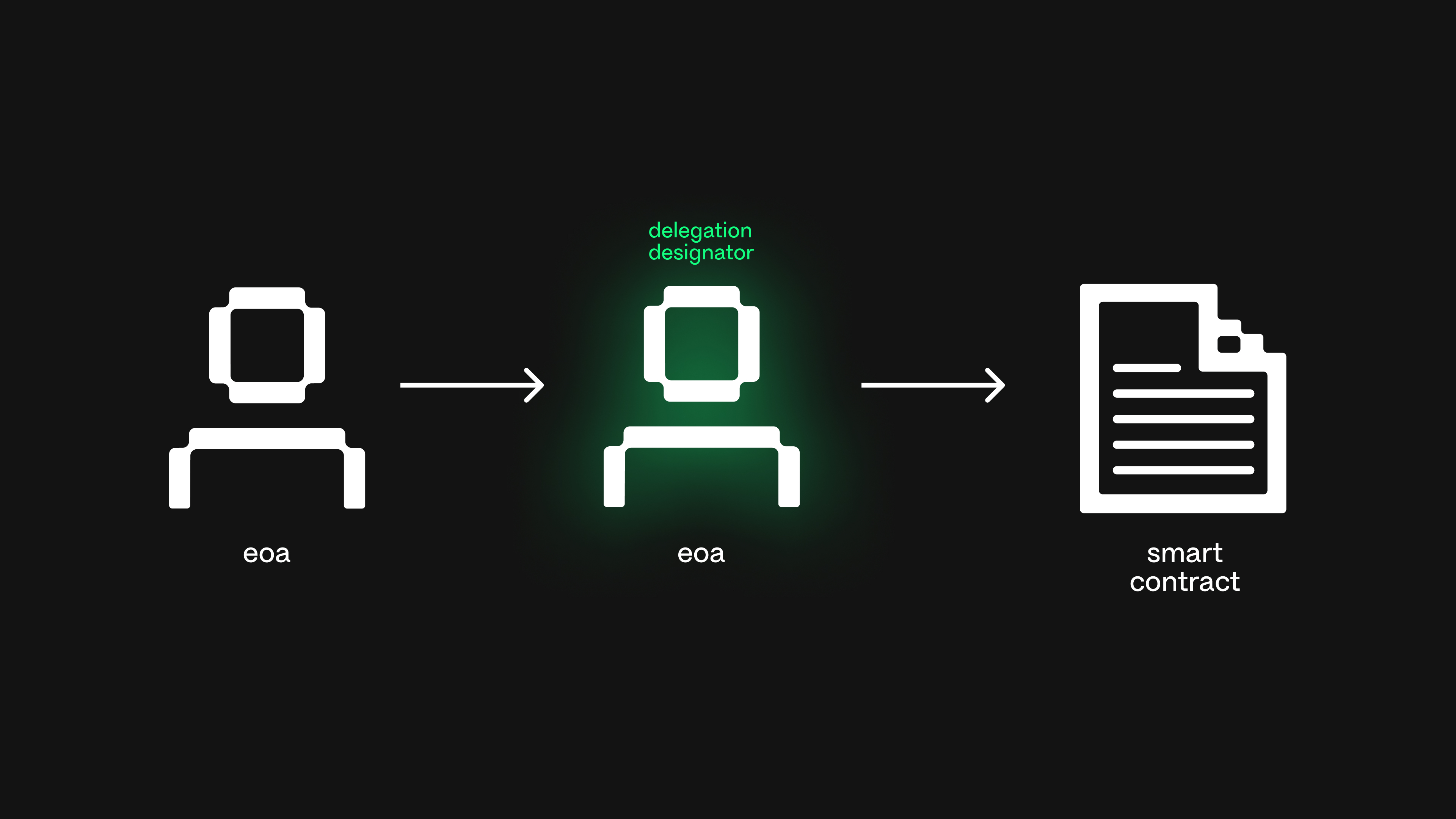
The mechanism works by allowing an EOA to sign a special authorization message. This message records a smart contract's code in the EOA's account state, effectively turning the EOA into a "smart EOA" for the duration of the transaction [2]. Once the transaction completes, the EOA reverts to its standard state, retaining its simple ownership structure while gaining the flexibility of a smart contract when needed.
This capability enables practical use cases like session keys and gas sponsorship. Users can authorize a specific dApp to interact with their funds for a limited time or allow a third party to pay transaction fees on their behalf. Unlike ERC-4337, which requires deploying new smart contract accounts, EIP-7702 upgrades existing wallets through a protocol-level change, making it a seamless transition for the broader user base [3].
ERC-4337 vs EIP-7702 architecture
The fundamental difference between ERC-4337 and EIP-7702 lies in how they treat the Ethereum address. ERC-4337 introduced account abstraction by creating entirely new smart contract accounts that sit alongside existing EOAs. EIP-7702, implemented on May 7, 2025, takes a different path by upgrading existing EOAs to temporarily behave like smart contracts.
ERC-4337: Separate Smart Accounts
ERC-4337 operates through a separate entry point contract and relies on "bundlers" to package transactions. Users must deploy a new smart contract wallet address to access features like session keys or gas sponsorship. This approach requires a migration step, as the user's original EOA remains unchanged and lacks these capabilities. The standard is robust and widely supported by infrastructure providers like Pimlico, but it fragments the user's asset holdings across multiple addresses.
EIP-7702: Upgraded EOAs
EIP-7702 allows an EOA to delegate execution to a smart contract without changing its address. By signing a special authorization message, an EOA can set its own code, effectively becoming a smart account for that session. This eliminates the need for users to deploy new wallets or manage multiple addresses. Since it requires a protocol-level upgrade (the Pectra hardfork), it is natively integrated into the Ethereum state, offering a more seamless experience for users already holding ETH in standard wallets.
| Feature | ERC-4337 | EIP-7702 | Migration |
|---|---|---|---|
| Account Type | New Smart Contract | Upgraded EOA | Deploy new wallet |
| Protocol Change | Requires Pectra hardfork | N/A | |
| Gas Sponsorship | Via Paymasters | Via delegated contracts | N/A |
| Session Keys | Native support | Native support | N/A |
| Address Stability | Changes address | Keeps original EOA | N/A |
Wallet and dapp integration paths
The integration path for ERC-4337 and EIP-7702 diverges fundamentally in how they handle transaction execution and gas management. ERC-4337 operates as a layer-2 abstraction, relying on a decentralized network of bundlers to package user operations into valid transactions. In contrast, EIP-7702 integrates directly into the Ethereum protocol, allowing EOAs to temporarily adopt smart contract code via authorization signatures. This distinction dictates entirely different engineering approaches for developers building on-chain applications.
ERC-4337: Bundlers and Paymasters
Implementing ERC-4337 requires integrating with a bundler service and often a paymaster contract. The bundler is responsible for collecting user operations, prioritizing them, and submitting them to the mempool as standard transactions. This adds latency and complexity to the transaction lifecycle. Developers must manage the bundler API and handle potential failures if bundlers are unavailable or censoring specific operations.
Gas sponsorship is achieved through paymasters, which allow applications to pay gas fees on behalf of users. This requires the developer to deploy and maintain a paymaster contract that verifies the user's eligibility for sponsorship. While this enables gasless transactions, it introduces counterparty risk; if the paymaster contract is compromised or lacks sufficient funds, the user's operation will fail. The developer must also implement signature verification logic to ensure the user operation was authorized by the correct account.
EIP-7702: Authorization Signatures
EIP-7702 simplifies the integration by leveraging standard transaction types. Instead of relying on an external bundler, the user's wallet sends a standard transaction that includes an authorization_list. This list contains a signature from the EOA authorizing a specific smart contract to act on its behalf. The Ethereum node validates this signature and temporarily sets the EOA's code to the authorized contract.
This approach eliminates the need for a bundler for standard transactions. Gas sponsorship can be handled by the authorized smart contract itself, which can pay for its own execution or relay transactions. The developer's primary responsibility is to generate and manage these authorization signatures securely. The wallet must ensure that the signature is valid and that the authorized contract has the necessary permissions. This reduces the infrastructure burden compared to ERC-4337, as the validation logic is handled by the Ethereum protocol.
Comparison of Integration Requirements
The table below summarizes the key differences in integration requirements for developers.
| Feature | ERC-4337 | EIP-7702 |
|---|---|---|
| Transaction Submission | Standard Tx | |
| Gas Sponsorship | Paymaster Contract | Authorized Contract |
| Validation Logic | Bundler/Node | Protocol |
| Infrastructure | High | Low |
Use Case Considerations
For applications requiring complex batched transactions or advanced account logic, ERC-4337 remains a robust choice due to its flexibility. However, for simpler use cases like gas sponsorship or session keys, EIP-7702 offers a more streamlined integration. Developers should evaluate the specific needs of their application and the target user base when choosing between these two paths. The choice will impact the user experience, development cost, and long-term maintenance burden.
Adoption trends and wallet support
By 2026, the landscape for Ethereum account abstraction has solidified around two distinct paths: EIP-7702, activated in the May 2025 Pectra upgrade, and the ERC-4337 ecosystem. While EIP-7702 allows existing externally owned accounts (EOAs) to temporarily set their own code, ERC-4337 relies on smart contract accounts that operate independently of the base protocol. The result is a market where major wallets now support both models, catering to different user needs.
Major wallet providers have integrated EIP-7702 support to enable features like session keys and gas sponsorship without requiring users to migrate funds to new addresses. This non-migratory approach was a key design goal of the EIP, allowing users to retain their familiar addresses while gaining smart contract capabilities. You can verify which wallets currently support EIP-7702 through the WalletBeat directory, which tracks real-time compatibility across the ecosystem.
ERC-4337 continues to grow through its infrastructure layer, with bundlers and paymasters like Pimlico providing the backbone for smart account transactions. Unlike EIP-7702, ERC-4337 does not require protocol upgrades, allowing for more flexible and rapid iteration of account features. For developers choosing between the two, EIP-7702 offers a seamless upgrade for existing EOAs, while ERC-4337 provides a more robust framework for complex, multi-party smart accounts.
Choosing the right abstraction standard
Selecting between EIP-7702 and ERC-4337 depends on your specific UX requirements and technical constraints. EIP-7702 enables seamless EOA upgrades by allowing users to temporarily delegate execution to smart contracts, while ERC-4337 provides a comprehensive account abstraction layer with paymaster-driven gas sponsorship. The decision often hinges on whether you prioritize native integration or flexible sponsorship.
| Feature | EIP-7702 | ERC-4337 |
|---|---|---|
| Gas Sponsorship | Limited | Full Paymaster Support |
| User Migration | Native EOA Upgrade | Smart Contract Wallet |
| Complexity | Lower | Higher |
For most projects seeking immediate EOA upgrades with minimal friction, EIP-7702 offers a streamlined path. However, applications requiring sophisticated gas sponsorship or custom validation logic should stick with ERC-4337. Review the EIP-7702 specification and ERC-4337 documentation for detailed implementation guidelines.
Frequently asked: what to check next
Is EIP-7702 implemented?
Yes. EIP-7702 activated on Ethereum mainnet on May 7, 2025, as part of the Pectra hardfork. It is now live, allowing any existing EOA to temporarily set its own code and delegate execution to a smart contract.
What new capability does EIP-7702 give to an EOA?
EIP-7702 introduces a new transaction type with an "authorizations" field. Users sign a special authorization message from their EOA, which is recorded on the Ethereum network, allowing them to delegate execution to a smart contract without changing their address.
What is the difference between EIP-4337 and EIP-7702?
ERC-4337 defines a standard interface for smart accounts that plug into standard relayers and paymasters without requiring protocol upgrades. EIP-7702 allows existing EOAs to become smart accounts but requires a protocol upgrade.
Which wallets support EIP-7702?
Wallet support is rapidly expanding. You can check the latest compatibility status on WalletBeat, which tracks which wallets have integrated EIP-7702 features.
No comments yet. Be the first to share your thoughts!