
What EIP-7702 Migration Actually Means
The term "migration" often triggers anxiety in crypto, but EIP-7702 requires no asset transfers or bridge risks. It is a protocol-level upgrade that allows Externally Owned Accounts (EOAs)—your standard wallet addresses—to execute smart contract logic without changing the address itself.
Think of your EOA as a house. Before EIP-7702, the house could only receive mail and store items. With this upgrade, you don't move to a new house; you simply install a smart lock that allows authorized contractors (smart contracts) to enter and perform specific tasks on your behalf. Your address remains the same, but its capabilities expand significantly.
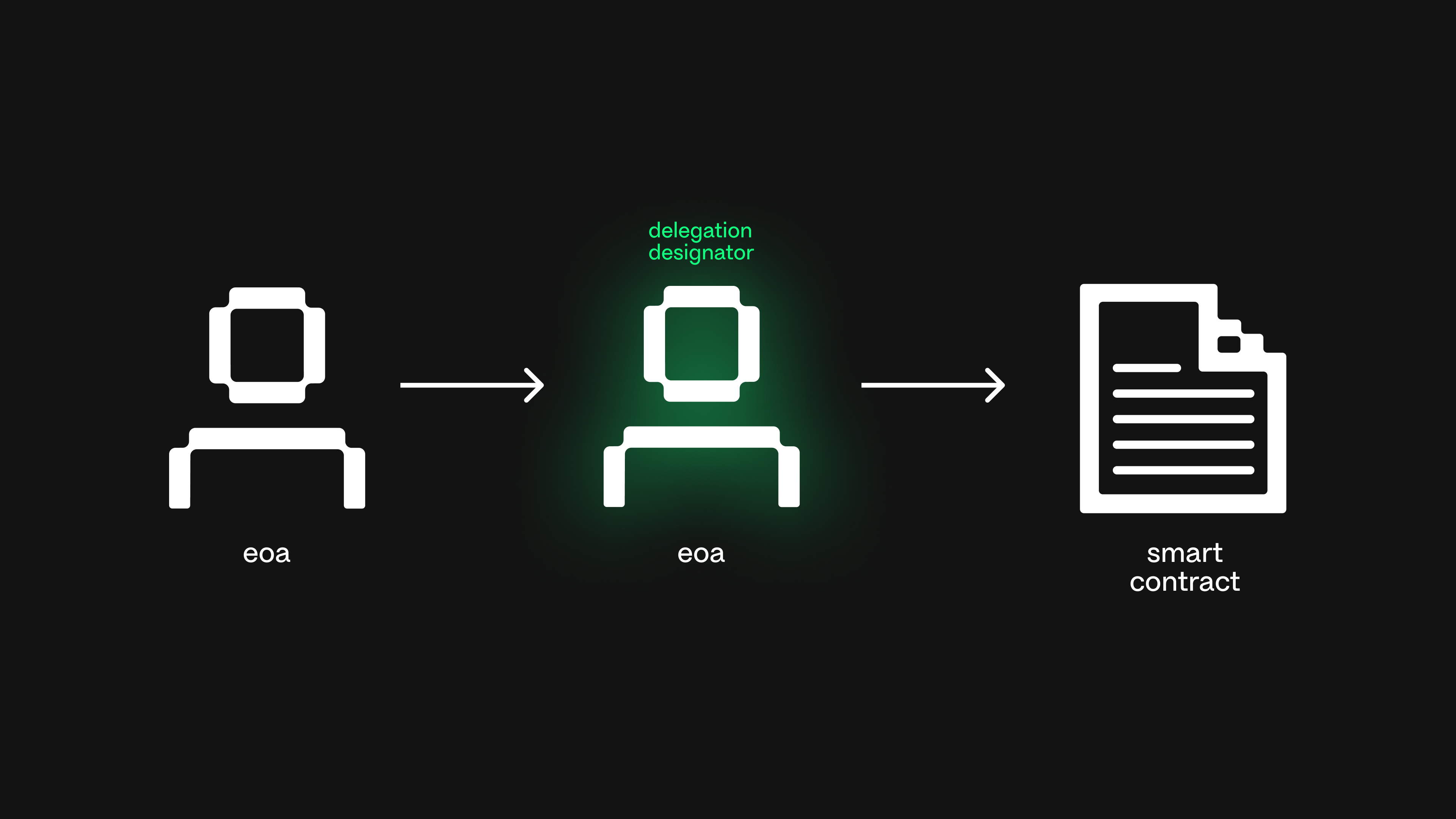
This is achieved through a new transaction type that includes an "authorizations" field. Instead of moving your assets, you sign a special authorization message from your EOA. This signature is recorded on the Ethereum network, effectively linking your EOA to a smart contract. The contract can then execute transactions on your behalf, enabling features like gas sponsorship, transaction batching, and social recovery, all while the assets remain in the original EOA.
This approach differs fundamentally from ERC-4337 (Account Abstraction). While ERC-4337 introduced smart accounts that live on entirely new addresses and require bundlers to process transactions, EIP-7702 is complementary. It upgrades the existing EOA infrastructure. You are not replacing your wallet; you are extending its native functionality. This means you retain the simplicity of a standard wallet for everyday use while gaining the advanced features of smart accounts when needed.
The result is a "Smart EOA"—an account that looks and feels like a regular wallet but can delegate execution to smart contracts. This eliminates the friction of migrating assets to a new smart account contract, reducing both the technical barrier to entry and the security risks associated with bridge transactions. For users and developers, this means account abstraction can be adopted incrementally, without forcing a complete overhaul of existing wallet ecosystems.
How authorizations replace private key signatures
EIP-7702 introduces a new transaction type (0x04) that allows Externally Owned Accounts (EOAs) to set their code to point to a delegate smart contract. This mechanism effectively upgrades a standard wallet to a "Smart EOA" without changing the underlying address or requiring the user to migrate funds. The core innovation lies in how these upgrades are authorized: instead of relying on complex account abstraction logic or third-party relayers, the EOA owner simply signs a special authorization message. This signature is recorded on the Ethereum network, granting a smart contract the power to execute transactions on the user's behalf.
The process is straightforward and mirrors familiar wallet interactions. When a user wants to enable features like gas sponsorship or transaction batching, they sign an authorization payload using their private key. This payload specifies the target smart contract address and the chain ID. Once the transaction is mined, the EOA's code field is updated to point to that contract. From that moment forward, the smart contract can initiate calls to the EOA, enabling complex logic while the user retains full control over their funds and signing authority.
This approach offers significant advantages over traditional account abstraction. Because the EOA remains the primary actor, users do not need to manage seed phrases for multiple accounts or deal with contract deployment risks. The authorization is revocable, meaning users can reset their EOA to its original state by signing a new transaction with an empty code field. This flexibility makes EIP-7702 a powerful tool for improving user experience without sacrificing the security and simplicity of EOAs.
The user or their application constructs an authorization message containing the target contract address, a nonce, and the chain ID. This payload defines which smart contract will be delegated to and ensures the authorization is unique to the specific chain and contract instance.
The user signs the authorization payload using their EOA's private key. This step is identical to signing a standard transaction, ensuring that the user maintains full control and understanding of the action. The signature proves that the EOA owner consents to the delegation.
The signed authorization is submitted as a new 0x04 transaction type to the Ethereum network. Once mined, the network updates the EOA's code field to point to the delegated smart contract. The EOA is now a Smart EOA, ready to execute delegated logic.
EIP-7702 vs ERC-4337: Complementary paths
EIP-7702 and ERC-4337 are often compared, but they solve different layers of the account abstraction puzzle. EIP-7702 upgrades the Ethereum Account Object (EAO) itself, allowing standard EOAs to delegate execution to smart contracts without changing their address. ERC-4337, by contrast, standardizes the off-chain infrastructure—specifically bundlers and paymasters—that handles transaction relaying and sponsorship.
Think of ERC-4337 as the logistics network that processes complex transactions on behalf of users, while EIP-7702 is the upgrade to the vehicle itself, allowing it to drive itself. They are not mutually exclusive. In fact, EIP-7702 is complementary to ERC-4337, not a replacement. An EOA activated via EIP-7702 can still utilize ERC-4337 bundlers for gas sponsorship, combining the best of both worlds.
The table below breaks down the core differences in implementation, user experience, and gas mechanics.
| Feature | EIP-7702 | ERC-4337 |
|---|---|---|
| Implementation Layer | On-chain (Protocol Level) | Off-chain (Mempool/Bundle Level) |
| User Experience | Native EOA experience; no address change | |
| Gas Sponsorship | Optional; relies on Paymaster if used | Core feature; built-in Paymaster support |
| Complex Transactions | Batched via delegated smart contract | Batched via UserOperation structure |
| Adoption Barrier | Low (backward compatible with EOAs) | Medium (requires wallet provider support) |
For developers, this means EIP-7702 lowers the barrier to entry for account abstraction by making it native to the most common account type: the EOA. Users get programmable features without needing to migrate funds to a new wallet address. ERC-4337 remains essential for applications that need sophisticated transaction batching or gasless experiences that go beyond what a delegated EOA can easily handle.
The choice between them often depends on your application's needs. If you want to upgrade existing users with minimal friction, EIP-7702 is the immediate path. If you need deep customization of the transaction lifecycle, ERC-4337 provides the infrastructure layer to build it.
Wallet support and adoption in 2026
By 2026, EIP-7702 has moved from a protocol upgrade to a standard feature set across the Ethereum ecosystem. The primary advantage for users is that existing Externally Owned Accounts (EOAs) can now delegate execution to smart contracts without changing their address. This seamless transition has driven rapid adoption among wallet providers who prioritize backward compatibility.
Major infrastructure providers have integrated EIP-7702 to support advanced user experience features. Safe (formerly Gnosis Safe) offers comprehensive documentation and tooling for deploying smart accounts via 7702 authorizations, allowing users to retain their EOA address while gaining smart account capabilities like gas sponsorship and batching. Fireblocks, a leading institutional custody provider, has also enabled 7702 support, allowing enterprises to ship smart account functionality directly without deploying separate contract deployments for every user.
The distinction between EIP-7702 and ERC-4337 remains important for developers. While 4337 standardizes how accounts interact with bundlers and paymasters, 7702 upgrades the account itself at the protocol level. Wallets like Biconomy and OpenFort leverage this complementarity, offering 7702-native experiences that feel identical to traditional EOAs but unlock smart account power.
For users verifying compatibility, the landscape is consolidating around a few key players. Wallet providers that have already implemented 7702 typically list it under "smart account" or "account abstraction" features. Since the activation, most major non-custodial wallets have enabled 7702 by default, ensuring that users can benefit from improved UX without manual configuration.
No comments yet. Be the first to share your thoughts!