
EIP-7702 migration 2026 explained
EIP-7702, a core component of the upcoming Pectra upgrade, introduces a mechanism that allows externally owned accounts (EOAs) to temporarily delegate their execution authority to smart contracts. This change blurs the historical distinction between simple key-controlled wallets and smart contract accounts, enabling EOAs to access advanced functionality without requiring the user to deploy a new contract or change their address.
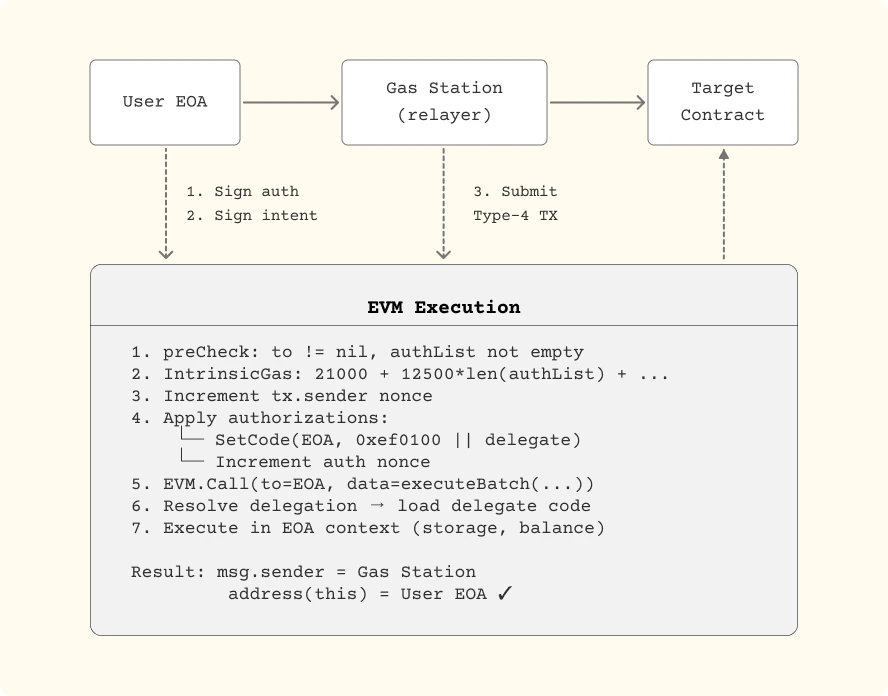
The upgrade works by allowing an EOA to set a delegation target. When the EOA signs a transaction, the Ethereum Virtual Machine (EVM) checks for this delegation and executes the code at the target contract address instead of the EOA itself. This process is temporary and transaction-specific, meaning the EOA retains its original private key control while gaining the programmability of a smart contract for that specific interaction.
For enterprises, this migration offers a path to modernize legacy wallets. Organizations can maintain their existing EOA infrastructure while adopting features like gas sponsorship, transaction batching, and multi-signature logic through smart contract implementations. This approach reduces the friction of migrating users to entirely new wallet architectures while unlocking the security and flexibility benefits of account abstraction.
The implementation aligns with the broader Ethereum Account Abstraction roadmap, building on lessons from earlier proposals like EIP-3074. By focusing on per-transaction delegation rather than persistent invoker roles, EIP-7702 addresses previous security concerns while providing a scalable foundation for next-generation wallet solutions.
EOA delegation versus full smart wallets
EIP-7702 and ERC-4337 represent two distinct paths to account abstraction, each with different trade-offs for enterprise deployment. EIP-7702 allows externally owned accounts (EOAs) to temporarily delegate execution to smart contracts, effectively granting smart capabilities without changing the underlying address. This approach is designed to be a bridge, enabling features like gas sponsorship and transaction batching while maintaining the simplicity of standard key-based accounts. However, these capabilities are transient; once the delegated transaction sequence ends, the EOA reverts to its basic state.
In contrast, ERC-4337 introduces persistent smart contract accounts that operate independently of EOAs. These accounts live on the blockchain as code, offering permanent access to advanced features such as multi-signature requirements, social recovery, and complex spending policies. For enterprises, this persistence is critical for long-term governance and security protocols that cannot rely on temporary delegation states. The trade-off is complexity: ERC-4337 requires users to deploy and manage contract accounts, which can introduce friction during onboarding.
| Feature | EIP-7702 (Smart EOAs) | ERC-4337 (Smart Accounts) |
|---|---|---|
| Account Type | Existing EOA with temporary delegation | New smart contract account |
| Persistence | Transient (session-based) | Permanent |
| Onboarding | Zero (uses existing address) | Requires deployment |
| Recovery | Limited (standard key loss) | Social recovery possible |
| Gas Sponsorship | Supported | Supported |
| Multi-Sig | Limited via delegation | Native support |
The choice between these models depends on the enterprise's risk tolerance and user base. EIP-7702 is ideal for organizations seeking to enhance existing EOA-based workflows with minimal friction, such as sponsoring gas for employees or enabling batched payments. ERC-4337 is better suited for applications requiring robust, long-term account security and governance, such as treasury management or multi-party collaboration tools.
| Feature | EIP-7702 | ERC-4337 |
|---|---|---|
| Account Type | EOA | Smart Contract |
| Persistence | Temporary | Permanent |
| Recovery | No | Yes |
| Gas Sponsorship | Yes | Yes |
For enterprises evaluating these options, the decision often comes down to whether the immediate need is to enhance existing accounts or to build a new, more secure infrastructure. EIP-7702 offers a quick win for modernizing legacy systems, while ERC-4337 provides a foundation for future-proof, enterprise-grade wallet solutions.
Enterprise use cases for EIP-7702
EIP-7702 transforms externally owned accounts (EOAs) into smart contract wallets without requiring users to deploy new contracts or migrate funds. For enterprises, this capability bridges the gap between traditional user experience and advanced account abstraction features. The primary value lies in enabling gasless transactions and session keys directly from existing wallets, reducing friction for mass adoption.
Gasless Transactions with USDC
One of the most immediate enterprise applications is gasless transactions, particularly for stablecoin transfers. Circle’s integration of EIP-7702 with the Pectra upgrade allows EOAs to sponsor USDC transactions. This means enterprises can cover gas fees for their users, eliminating the need for users to hold ETH for network fees. This is critical for B2B payments and payroll systems where requiring users to manage gas tokens creates unnecessary operational overhead.
Session Keys for Controlled Access
Session keys provide a secure way to grant temporary, limited permissions to third-party applications. Instead of exposing private keys or requiring constant signature approvals, enterprises can issue session keys that allow specific actions—such as swapping tokens or interacting with a dApp—for a set duration or limit. This enhances security by minimizing the attack surface while maintaining a smooth user experience for high-frequency interactions.
Wallet support and migration tooling
Enterprise adoption of EIP-7702 hinges on the maturity of wallet infrastructure. The protocol enables Externally Owned Accounts (EOAs) to execute smart contract code, effectively granting them account abstraction features like gas sponsorship and session keys without changing the underlying address. This capability allows enterprises to upgrade legacy wallets to smart contract standards incrementally, reducing the friction typically associated with migrating to full Smart Contract Wallets (SCWs).
Current support is fragmented but rapidly expanding. Leading custodial and non-custodial platforms, including Safe and Biconomy, have integrated EIP-7702 support to facilitate this transition. These tools allow enterprises to deploy EOA wallets that can immediately leverage advanced security features and transaction batching. The shift from EIP-3074 to EIP-7702 was driven by security concerns; the new proposal offers per-transaction execution, aligning more safely with the broader ERC-4337 ecosystem while avoiding the persistent invoker risks of earlier attempts.
| Feature | Legacy EOA | EIP-7702 EOA | Smart Contract Wallet |
|---|---|---|---|
| Address Change | No | No | Yes |
| Gas Sponsorship | No | Yes | Yes |
| Session Keys | No | Yes | Yes |
| Recovery | No | Complex | Yes |
| Deployment Cost | Zero | Zero | High |
For enterprises, the primary advantage is the ability to enhance security and user experience without forcing users to migrate to new addresses. Tooling providers are currently focusing on seamless integration, allowing existing EOA users to sign a single authorization transaction to activate smart contract capabilities. This approach minimizes user friction and reduces the operational overhead of managing multiple wallet standards across an organization.
Security considerations for delegated accounts
EIP-7702 introduces a fundamental shift in how externally owned accounts (EOAs) operate on Ethereum. By enabling code execution on EOAs, it blurs the line between simple wallets and smart contract accounts, all without changing user addresses or requiring contract deployments [src-serp-3]. This capability allows enterprises to leverage smart contract features like gas sponsorship and batching while maintaining the simplicity of standard key management.
The primary security advantage of EIP-7702 is its transient nature. Delegation is not persistent; it must be renewed with every transaction. This design prevents the long-term exposure risks associated with earlier proposals like EIP-3074, which posed security risks due to persistent invokers and lacked forward compatibility [src-serp-4]. For enterprise risk managers, this means that even if a delegation signature is compromised, the window of exploitation is limited to a single transaction block.
However, this model introduces new attack vectors. The core risk lies in the revocation process. If an enterprise account delegates authority to a smart contract wallet, the account holder must actively revoke this delegation when the contract is no longer trusted or when the relationship ends. Failure to revoke can leave the account vulnerable to malicious updates in the delegated contract code. Enterprises must implement strict internal protocols to monitor and manage these delegation states.
Another consideration is the potential for reentrancy attacks during the delegation process. Since the delegation code is executed within the context of the transaction, a malicious contract could attempt to re-enter the delegation logic before the state is fully updated. While the EIP specification includes safeguards, enterprise auditors must verify that the specific smart contract wallets being used adhere to these standards.
The alignment of EIP-7702 with ERC-4337 further enhances security by providing a standardized framework for account abstraction. This compatibility ensures that security tools and monitoring systems designed for ERC-4337 can be adapted for EIP-7702 accounts, providing enterprises with a more robust security posture. As the ecosystem matures, we expect to see more sophisticated security tools specifically designed for managing delegated EOA states.
Frequently asked: what to check next
Is EIP-7702 implemented?
Yes. EIP-7702 is enabled by default on the Ethereum mainnet. This activation allows Externally Owned Accounts (EOAs) to temporarily delegate authority to smart contracts, unlocking features like gas sponsorship and transaction batching while retaining the original user address.
What is the difference between EIP-3074 and EIP-7702?
EIP-3074 proposed persistent invoker opcodes that posed significant security risks and lacked forward compatibility. In contrast, EIP-7702 enables per-transaction smart contract features, offering a safer and more scalable path that aligns closely with the broader Ethereum account abstraction roadmap.
What new capability does EIP-7702 give to an eOA?
EIP-7702 introduces a fundamental shift by allowing EOAs to execute code. This blurs the line between simple wallets and smart contract accounts, enabling complex logic without requiring users to deploy new contracts or change their existing addresses.
Which wallets support EIP-7702?
Support is growing rapidly among major wallet providers. You can check the current compatibility list on WalletBeat to see which interfaces are ready for 7702-enabled transactions in 2026.
No comments yet. Be the first to share your thoughts!