
What EIP-7702 Does for EOAs
EIP-7702 fundamentally alters the Ethereum account model by allowing Externally Owned Accounts (EOAs)—standard wallet addresses controlled by private keys—to adopt smart contract capabilities. Previously, EOAs were limited to signing transactions, while only smart contract accounts could execute complex logic. This upgrade bridges that gap, enabling EOAs to interact with decentralized applications using advanced features like session keys and multi-party computation without requiring users to migrate their funds to a new wallet type.
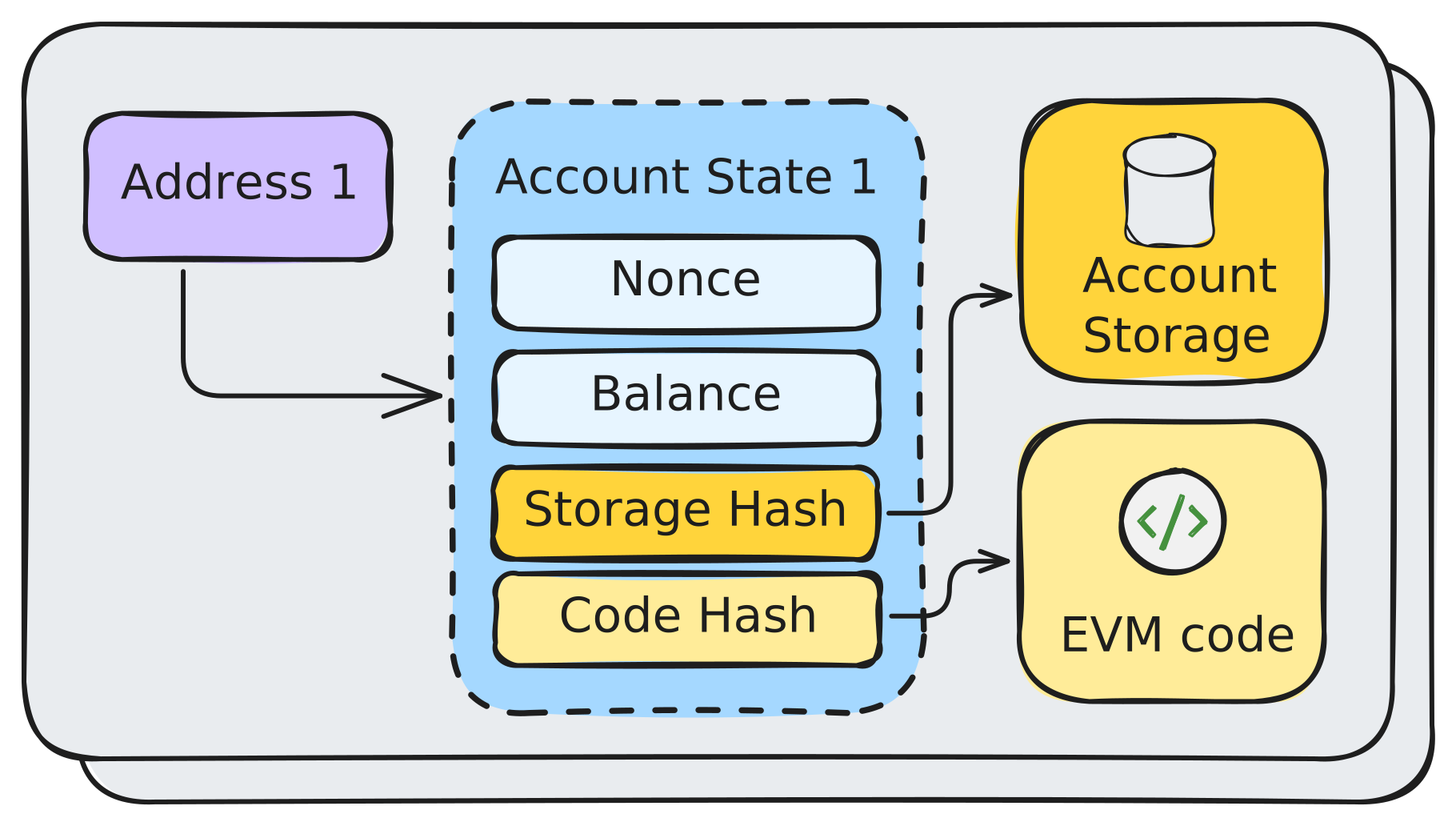
The mechanism works through a new transaction type, EIP-2718, which allows an EOA to set the code in its own account. This process, known as delegation, links the EOA to a smart contract. When the EOA sends a transaction, the Ethereum Virtual Machine (EVM) executes the delegated contract's code instead of the standard EOA logic. This allows the user to retain their familiar address and private key while gaining the flexibility of a smart contract, effectively decoupling identity from execution logic.
This approach resolves the "migration paradox" often seen in crypto upgrades. Users do not need to move their assets or change their addresses, which eliminates the risk of sending funds to an incorrect contract address or interacting with phishing sites disguised as migration portals. Instead, the "migration" happens at the protocol level, upgrading the capabilities of the existing account. This preserves user experience while introducing sophisticated security and automation features previously reserved for smart wallets.
By enabling EOAs to host code, EIP-7702 paves the way for account abstraction without forcing a hard fork of the user base. Users can now implement features like paymasters for gas sponsorship or multi-signature requirements directly from their existing wallets. This creates a more seamless transition to advanced crypto interactions, allowing the ecosystem to evolve its security and functionality standards while keeping users anchored to their established identities.
Why 2026 Is the Migration Year
The Ethereum Pectra upgrade, activated in May 2025, fundamentally shifted the timeline for smart wallet adoption. While the technical capabilities were introduced in 2025, 2026 has emerged as the critical year for widespread implementation. This shift is driven by the convergence of EIP-7702 and ERC-4337, which together allow users to access smart wallet features without the traditional friction of migrating funds.
Previously, adopting a smart wallet required a complex migration process: deploying a new smart contract account and transferring all assets from the old externally owned account (EOA). EIP-7702 changes this dynamic by allowing EOAs to temporarily adopt smart wallet behavior. Users can now leverage features like gasless transactions and session keys directly from their standard Ethereum addresses, effectively migrating their features rather than their funds.
This distinction is vital for mass adoption. By removing the need for a one-time, irreversible migration of assets, the barrier to entry drops significantly. Users can experiment with smart wallet functionalities—such as paymasters and account abstraction—without the risk or complexity of moving their entire portfolio. As a result, 2026 marks the year where the utility of smart wallets becomes accessible to the broader Ethereum user base, not just those comfortable with technical migrations.
EOA Delegation vs. Full Smart Accounts
EIP-7702 introduces a temporary delegation mechanism that allows Externally Owned Accounts (EOAs) to borrow features from smart contract wallets without permanently changing their underlying structure. This approach sits between the traditional key-based security of EOAs and the programmable flexibility of ERC-4337 smart accounts. Understanding the distinction helps users decide whether to adopt a hybrid model or commit to a full migration.
The core difference lies in permanence and control. With EIP-7702, an EOA signs a specific transaction to delegate execution rights to a smart contract. This delegation is reversible and can be reset by signing another transaction or simply by not renewing the delegation. In contrast, a full smart account (like Safe) is a contract deployed on-chain from the start. The user interacts with the contract directly, meaning the account logic is immutable unless upgraded through a multi-sig or social recovery process.
Comparison of Account Models
The following table outlines the functional trade-offs between the temporary delegation of EIP-7702 and the permanent structure of ERC-4337 smart accounts.
| Feature | EIP-7702 Delegation | ERC-4337 Smart Account |
|---|---|---|
| Account Type | EOA (temporarily programmable) | Smart Contract (permanent) |
| Reversibility | High (reset delegation anytime) | Low (requires contract upgrade) |
| Gas Sponsorship | Yes (via delegated contract) | Yes (via Paymaster) |
| Session Keys | Yes (native support) | Yes (via contract logic) |
| Recovery | Limited (depends on delegated logic) | High (social/multi-sig recovery) |
| Complexity | Low (EOA-centric) | High (contract deployment needed) |
When to Choose Which
EIP-7702 is ideal for users who want immediate access to advanced features like batched transactions and gas sponsorship without the friction of deploying a new contract. It is a "migration of features, not funds," allowing seamless integration with existing wallets. However, it lacks the robust recovery mechanisms inherent to full smart accounts.
Full smart accounts remain the superior choice for high-value holdings or organizational use cases where recovery options and immutable logic are critical. The deployment cost and learning curve are higher, but the security and flexibility benefits are permanent. For most everyday users, EIP-7702 offers a pragmatic middle ground that bridges the gap between simplicity and programmability.
Gas Sponsorship and Session Keys
EIP-7702 transforms how users interact with decentralized applications by bringing smart wallet features to standard Ethereum accounts. Instead of moving funds to a new contract, users delegate execution rights to their existing address. This migration of features, not funds, allows EOAs to act like smart wallets without the complexity of account abstraction deployments.
Gasless Transactions
Gas sponsorship removes the friction of holding ETH for transaction fees. With EIP-7702, dApps or third parties can pay gas on behalf of the user while the user retains full control over the execution. This enables seamless experiences for onboarding, where users can transact using stablecoins or other assets without needing a separate ETH balance.
Session Keys
Session keys offer a middle ground between full delegation and signing every transaction. Users can grant a dApp limited permissions for a specific duration or action set. This reduces the number of signature prompts, improving UX for gaming or frequent trading, while maintaining security by limiting the scope of delegated power.
This dual capability—paying for gas and managing permissions—makes EIP-7702 a pivotal step for mainstream adoption. It bridges the gap between the simplicity of EOAs and the flexibility of smart accounts, allowing developers to build richer applications without forcing users to migrate their assets.
Implementation Steps for dApps
Integrating EIP-7702 requires a shift in how your dApp constructs and signs transactions. Instead of treating EOAs as simple key holders, you must treat them as delegatable entities. This allows users to retain their familiar seed phrases while accessing smart contract features like session keys and gas sponsorship.
Ensure your wallet provider supports the eth_getCode and eth_sendRawTransaction methods with 7702-specific payloads. You must verify that your RPC node is configured to process SetCode transactions, which are the backbone of this upgrade. Without this backend support, the delegation logic will fail silently.
When a user initiates an action, construct a SetCode transaction that delegates their EOA to a specific smart contract wallet implementation. This transaction must include the authorized contract address and the expiration time for the delegation. The user signs this once, effectively upgrading their account’s capabilities without moving funds.
Leverage the delegated state to enable session keys for high-frequency interactions. Your dApp should generate temporary keys with limited scopes and durations, allowing users to interact with your interface without signing every single transaction with their main seed phrase. This drastically improves UX for gaming or DeFi applications.
Before mainnet deployment, rigorously test the delegation lifecycle. Verify that the EOA correctly reverts to its original state after the delegation expires or is revoked. Use testnets to simulate edge cases, such as failed delegation attempts or concurrent transactions, to ensure your dApp remains robust under all conditions.
-
Update provider to support 7702 payloads
-
Verify RPC node `SetCode` compatibility
-
Implement delegation and expiration logic
-
Test session key scoping and revocation
-
Audit mainnet deployment scripts
No comments yet. Be the first to share your thoughts!