
What EIP-7702 changes for EOAs
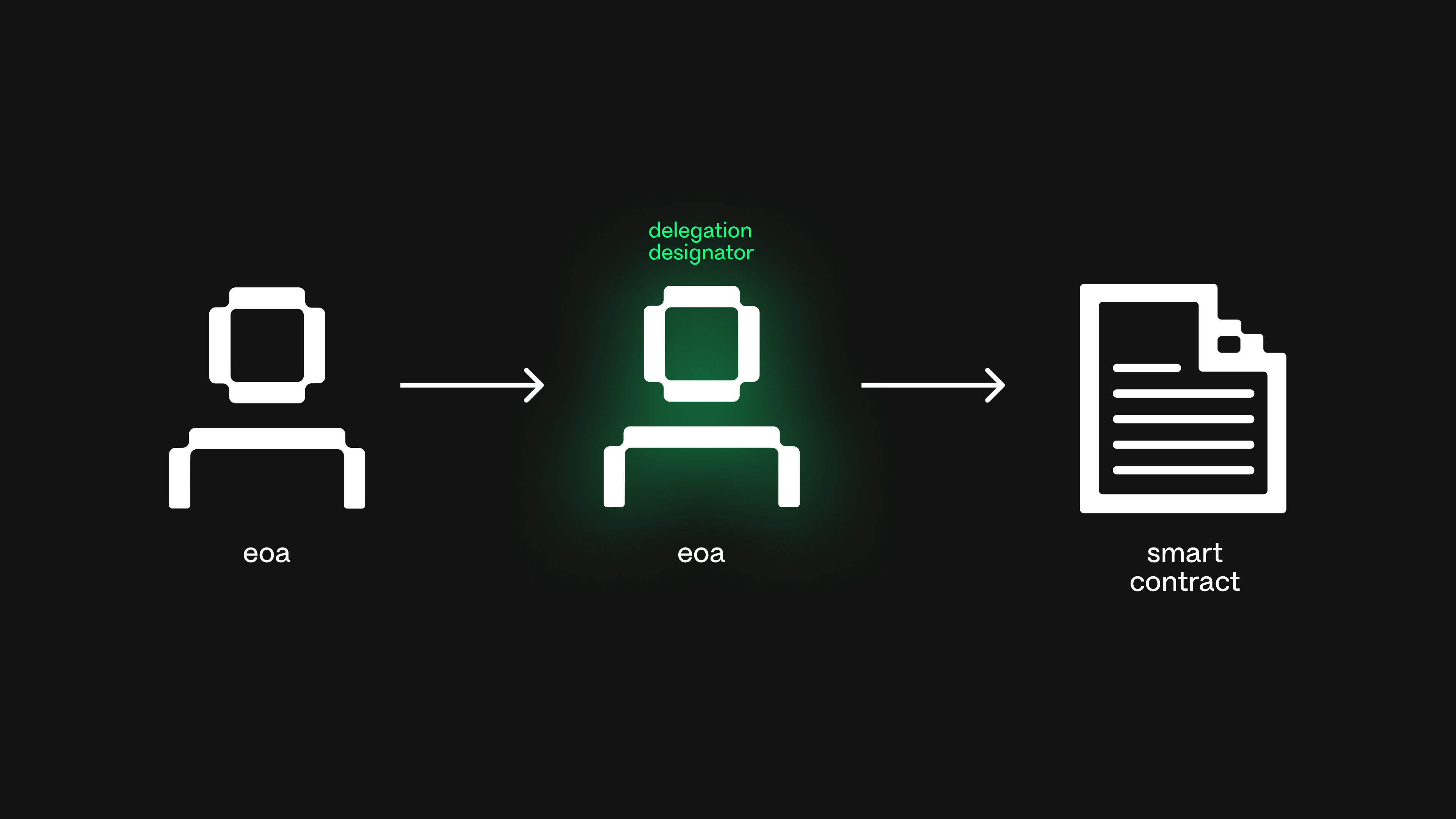
EIP-7702 allows standard Ethereum addresses (EOAs) to temporarily delegate code execution to smart contracts. This bridges the gap between legacy accounts and full account abstraction, enabling smart wallet features without requiring users to migrate to a new account type.
Previously, EOAs could only send transactions or pay for gas. They could not hold logic, enforce multi-signature rules, or execute complex scripts. EIP-7702 changes this by allowing an EOA to sign a specific transaction that attaches a smart contract’s code to its address. This delegation is temporary and revocable, giving the EOA the functional capabilities of a smart contract for the duration of the session or until the delegation is removed.
This capability is central to the Pectra upgrade, which aims to make Ethereum more flexible and user-friendly. By enabling EOAs to act like smart wallets, EIP-7702 allows for features like session keys, gas sponsorship, and advanced security policies without the friction of deploying a new contract or changing how users interact with their primary address.
The implementation is designed to be backward compatible. Existing EOAs continue to function as they do today, but they can opt-in to this new functionality when needed. This gradual approach ensures that the broader ecosystem can adopt the benefits of account abstraction without disrupting the current infrastructure or requiring a hard fork that forces mass migration.
How delegation works and where visibility breaks down
EIP-7702 introduces a delegation mechanism that allows an EOA to temporarily adopt the behavior of a smart contract. When a user delegates, they sign a specific transaction that registers a contract code hash on-chain. This action effectively turns the EOA into a "set-and-forget" agent for that contract's logic until the delegation is revoked or the session expires.
The technical advantage is clear: users can leverage complex smart contract functionality without deploying their own contract. However, this abstraction creates a significant visibility gap. Most wallet interfaces currently display transactions as simple value transfers or standard interactions. They do not explicitly signal that the underlying EOA is executing arbitrary smart contract code.
This opacity means that standard transaction previews can be misleading. A user might approve what appears to be a routine approval or transfer, unaware that the delegated contract is triggering a series of internal calls. Without explicit visual indicators in the wallet UI, users cannot easily distinguish between native EOA actions and delegated contract executions. This lack of transparency is a critical hurdle for widespread adoption, as it undermines the principle of informed consent in blockchain interactions.
For developers and wallet providers, the challenge is to make these delegated states visible. Until wallet interfaces explicitly highlight when an EOA is acting as a smart contract proxy, users remain exposed to risks they cannot easily perceive. The delegation itself is secure, but the user experience surrounding it is currently blind to the underlying mechanics.
EIP-7702 vs. ERC-4337: Side-by-Side Comparison
EIP-7702 and ERC-4337 both aim to modernize Ethereum accounts, but they take fundamentally different architectural paths. EIP-7702 modifies the core protocol to allow EOAs to temporarily delegate execution to smart contracts. In contrast, ERC-4337 operates as a layer-2 standard, relying on a separate network of bundlers and paymasters to process transactions.
Choosing between them depends on your priority: native integration or flexible abstraction. EIP-7702 offers lower friction for existing wallets by leveraging the existing EOA structure, while ERC-4337 provides superior customization for account recovery and gas sponsorship without requiring protocol-level changes.
The table below breaks down the technical and operational differences across key dimensions.
| Feature | EIP-7702 | ERC-4337 | Developer Impact |
|---|---|---|---|
| Architecture | Protocol-level modification | Layer-2 entry point | EIP-7702 requires client updates; ERC-4337 is software-only. |
| User Experience | Native EOA interaction | Session keys & sponsorship | ERC-4337 offers smoother onboarding; EIP-7702 feels familiar. |
| Gas Payments | Limited (native ETH) | Paymaster sponsorship | ERC-4337 enables gasless transactions; EIP-7702 is more restrictive. |
| Account Recovery | Requires smart contract logic | Built-in social recovery | ERC-4337 is better for consumer apps with lost keys. |
| Complexity | Moderate (stateful) | High (external bundlers) | EIP-7702 simplifies wallet code; ERC-4337 requires infrastructure. |
For developers building consumer-facing applications where gasless transactions and account recovery are critical, ERC-4337 remains the robust choice. However, for wallets seeking to upgrade existing EOAs with smart capabilities without introducing external infrastructure, EIP-7702 provides a more direct, native solution.
Security audit requirements for 2026
The introduction of EIP-7702 fundamentally changes how smart contracts interact with EOAs. For 2026, security audits must shift from static code review to dynamic behavior analysis. The core risk is not just what the contract does, but how it temporarily hijacks the execution context of a user's wallet.
Delegation Reentrancy Risks
EIP-7702 allows an EOA to delegate its execution to a smart contract for a single transaction. This creates a unique attack vector known as delegation reentrancy. If a contract calls an external function that triggers a callback to the same contract, the attacker can exploit the temporary delegation state. Unlike traditional reentrancy, which relies on storage manipulation, this exploits the transient authority granted by the SETCODE transaction type. Auditors must verify that no external calls can recursively trigger the delegation logic before the transaction completes.
Temporary Code Execution
The mechanism works by attaching code to an EOA for the duration of one transaction. This means the EOA behaves like a contract account only temporarily. Auditors must ensure that the contract code being delegated does not contain hidden fallback functions or unintended entry points. If the delegated code is not carefully sandboxed, it can execute arbitrary logic that persists beyond the immediate transaction scope, potentially draining funds or altering state in ways the user did not intend.
Audit Checklist
Developers and auditors should prioritize the following checks when reviewing EIP-7702 implementations:
- Verify that all external calls are guarded against reentrancy.
- Ensure delegated code is immutable and cannot be swapped mid-transaction.
- Test for edge cases where the EOA balance or nonce changes during execution.
- Confirm that the delegation is revoked immediately after the transaction concludes.
As noted in the official EIP-7702 documentation, migration strategies should account for contracts that previously relied on delegation patterns. If existing contracts used similar approaches, the transition may be smoother, but new implementations require rigorous testing to prevent exploitation of the temporary execution context.
DeFi Liquidity Implications and Trends
EIP-7702 changes how capital moves in DeFi by letting EOAs temporarily delegate to smart contracts. This capability enables gas sponsorship and session keys without requiring users to deploy new contracts. For lending and trading protocols, this shift reduces friction and lowers the cost of entry for everyday transactions.
The ability to sponsor gas means users can interact with protocols without holding native tokens for fees. This is particularly impactful for stablecoin transfers. As noted by Circle, the Pectra upgrade combined with EIP-7702 allows for gasless USDC transactions, making stablecoin usage smoother for non-technical users. This reduces the barrier to entry for liquidity provision and trading.
For lending protocols, session keys allow users to grant limited permissions for specific periods. This means users can interact with multiple lending positions without signing every single transaction. This efficiency can increase the velocity of capital within lending markets, as users are more likely to rebalance or adjust positions when the process is seamless.
However, these conveniences introduce new security tradeoffs. Delegating control to a smart contract, even temporarily, expands the attack surface. Users must carefully manage the scope and duration of these delegations. While the liquidity benefits are clear, the security implications require a more cautious approach to wallet management and protocol interaction.
Wallet integration steps for developers
Integrating EIP-7702 requires wallet providers to handle a new transaction type that allows EOAs to execute smart contract logic. This shift moves Ethereum closer to full account abstraction, but it introduces specific verification and delegation management challenges that must be addressed in your wallet’s core logic.
1. Update Transaction Parsing and Validation
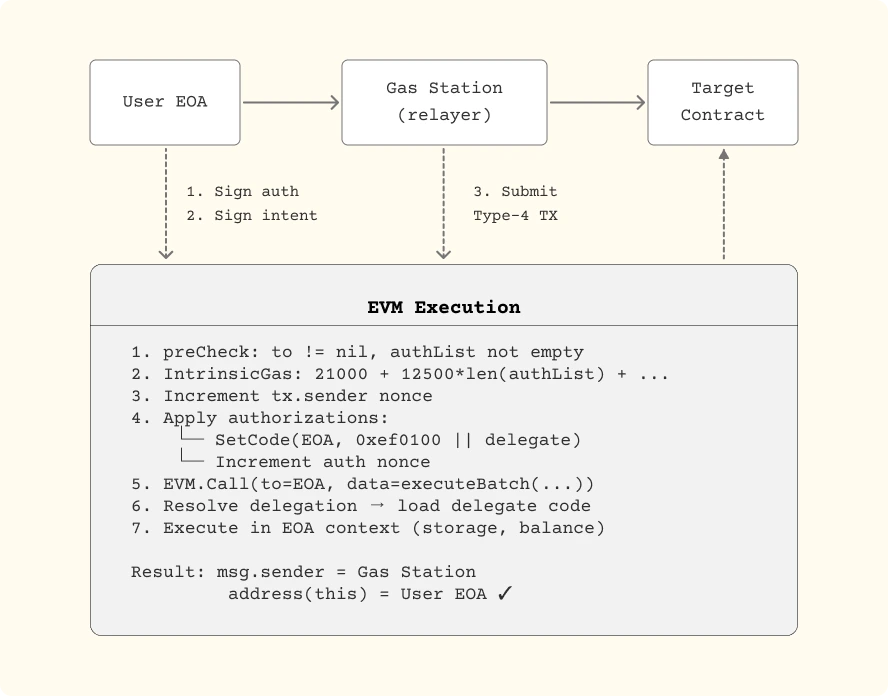
Your wallet must recognize the new type 4 transaction. When a user initiates a transaction, parse the authorizationList field within the transaction payload. Each authorization contains a signature, chain ID, address, and nonce. Validate these fields against the current network state to ensure the signature is valid and the nonce has not been used. Reject any transaction where the authorization list is malformed or the signature verification fails.
2. Implement Signature Verification Logic
EIP-7702 uses a specific signature format that differs from standard ECDSA signatures. You must implement the EIP-7702 signature verification algorithm, which involves hashing the authorization data and verifying it against the sender’s public key. Ensure your cryptographic libraries support the required elliptic curve operations. This step is critical for preventing unauthorized delegation of EOA capabilities to smart contracts.
3. Manage Delegation State
When a user delegates their EOA to a smart contract, the wallet must track this state. Store the delegation status locally and sync with the network to reflect any changes. If a user revokes delegation, update your local state immediately and inform the user. This visibility is essential for maintaining trust, as most users are unaware of the underlying delegation mechanics.
4. Update User Interface and Notifications
The user experience must clearly communicate when an EOA is being delegated or when a transaction involves smart contract execution. Display the delegated contract address and the actions it can perform. Avoid technical jargon; instead, use plain language to explain that the wallet is temporarily granting permissions to a specific contract. This transparency helps users understand the security implications of EIP-7702 transactions.
5. Test on Testnets and Mainnet Forks
Before deploying to mainnet, thoroughly test your integration on Sepolia or Holesky testnets. Use forked mainnet environments to simulate real-world conditions, including gas dynamics and competing transactions. Verify that your wallet handles edge cases, such as failed signature verifications or unexpected delegation revocations, gracefully. This rigorous testing ensures a smooth migration for your users.
Identify and extract the authorizationList from incoming transactions. Validate the structure and ensure all fields are present.
Implement the specific signature verification algorithm for EIP-7702 authorizations. Use robust cryptographic libraries to ensure accuracy.
Monitor and update the delegation status of each EOA. Sync with the blockchain to reflect real-time changes in delegation.
Design clear user interfaces that explain delegation and smart contract execution. Avoid technical jargon to maintain user trust.
Conduct comprehensive testing on Sepolia and Holesky. Use forked mainnet environments to simulate real-world scenarios.
Common questions about EIP-7702
EIP-7702 introduces a mechanism for EOAs to temporarily delegate their authority to smart contract logic. This change is central to the Pectra upgrade, aiming to improve wallet functionality without altering the fundamental nature of how users sign transactions. Below are the most frequent questions regarding backward compatibility and security implications.
The transition requires careful attention to wallet compatibility. While the Ethereum core developers have designed EIP-7702 to be backward compatible, third-party tools must explicitly implement support for the new transaction type. Users should verify their wallet providers have released updates prior to the upgrade activation.
No comments yet. Be the first to share your thoughts!