
What EIP-7702 does for EOAs
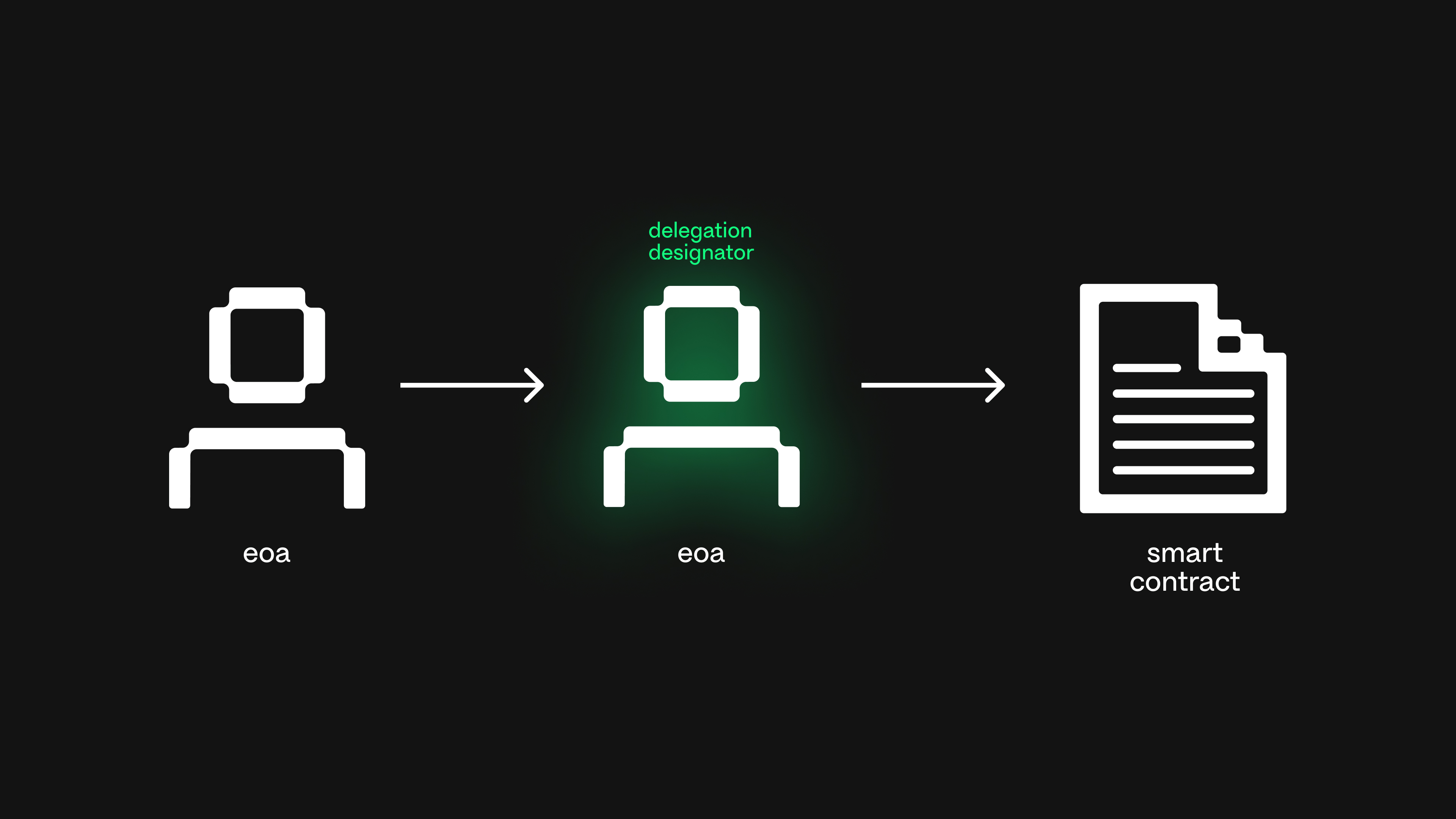
Ethereum’s Externally Owned Accounts (EOAs) have always had a fundamental limitation: they can hold funds and send transactions, but they cannot store code. EIP-7702 changes this by allowing an EOA to temporarily delegate its execution logic to an existing smart contract.
This mechanism bridges the gap between simple key-based accounts and full account abstraction. Instead of deploying a new contract or migrating funds, an EOA can sign a specific authorization that tells the Ethereum Virtual Machine (EVM) to treat its code as that of a designated contract during a transaction. Once the transaction completes, the EOA reverts to its standard behavior. This temporary delegation is the core innovation, offering the flexibility of smart contract wallets without the permanent complexity of account migration.
For users, this means unlocking features like transaction bundling, gas sponsorship, and custom permission rules directly from their existing wallets. It effectively gives EOAs "superpowers"—the ability to act like smart contract accounts while retaining the simplicity of private key control. This approach avoids the friction of ERC-4337, which relies on off-chain bundlers, by integrating account abstraction directly into the protocol layer. The result is a smoother path to advanced wallet functionality for the millions of users who still rely on traditional address-based accounts.
The implementation relies on a new transaction type defined in EIP-2718. When an EOA sends this transaction, it includes a signature that authorizes a specific contract address. The EVM then executes the transaction using the logic from that contract, allowing for complex operations that a standard EOA could not perform alone. This temporary state is crucial; it ensures that the EOA does not permanently become a smart contract, preserving the simplicity of key management for everyday use.
This innovation is particularly significant for the upcoming Pectra upgrade, where EIP-7702 is expected to enhance the network's usability. By allowing EOAs to tap into existing smart contract logic, developers can build more sophisticated wallet experiences without forcing users to adopt entirely new account structures. The technology promises to make Ethereum wallets more powerful while keeping the user experience familiar and straightforward.
EIP-7702 vs ERC-4337 differences
The distinction between EIP-7702 and ERC-4337 comes down to where the abstraction happens. EIP-7702 is a protocol-level change that allows Externally Owned Accounts (EOAs) to temporarily borrow logic from smart contracts. ERC-4337 is a user operation standard that relies on an off-chain mempool and bundlers to execute transactions without changing the base protocol.
Both enable account abstraction, but they solve the problem from opposite ends. EIP-7702 brings smart contract features to regular wallets by modifying how Ethereum validates transactions. ERC-4337 creates a parallel layer for smart contract wallets to operate independently of the core chain mechanics.
| Feature | EIP-7702 | ERC-4337 |
|---|---|---|
| Type | Protocol-level change (Type 4 tx) | User operation standard |
| Target | EOAs (regular wallets) | Smart Contract Wallets (SCWs) |
| Mechanism | Temporary code delegation | Off-chain mempool & bundlers |
| Implementation | Built into Ethereum client | External infrastructure layer |
EIP-7702 allows EOAs to sign a single authorization that delegates execution to a smart contract for one transaction. This temporary delegation enables features like transaction batching and gas sponsorship without permanently changing the wallet's code. The delegation is revoked after the transaction completes, keeping the EOA secure and simple.
ERC-4337, by contrast, requires users to interact with a smart contract wallet from the start. It uses a decentralized network of bundlers to package and submit user operations to the chain. This approach provides full account abstraction capabilities, such as social recovery and session keys, but relies on external infrastructure to function correctly.
Security risks in 7702 authorizations
EIP-7702 introduces a powerful mechanism: the ability for an externally owned account (EOA) to temporarily delegate its execution rights to a smart contract. This delegation is not a permanent transfer of ownership, but it creates a temporary window where the contract controls the funds. This architecture, while enabling advanced features like session keys and gas sponsorship, introduces specific attack vectors that did not exist before account abstraction.
The primary risk lies in the nature of the authorization itself. When you sign an EIP-7702 authorization, you are essentially telling the network, "For this period, this contract can act as me." If the delegated contract is compromised, the attacker gains immediate access to your funds during the authorization window. Unlike a traditional smart contract interaction where you approve a specific token transfer, here you are approving the code that runs the transaction. If that code contains a flaw or is malicious, the damage is direct and immediate.
Signature Replay and Reuse
One of the most critical technical risks is signature replay. An EIP-7702 authorization is a cryptographic signature that can be reused if not properly nonce-managed. If an attacker intercepts a valid authorization signature and replays it, they can trigger the delegated contract to execute actions on your behalf. This is particularly dangerous if the authorization is long-lived or if the nonce is not strictly enforced by the wallet implementation. Users must ensure their wallets properly track and increment nonces to prevent replay attacks.
The Revocation Problem
Revoking an EIP-7702 authorization is not as simple as signing a "cancel" transaction. Because the delegation modifies the account's code temporarily, revocation requires a specific transaction type to reset the account to its original state. If a user loses access to their private key or if the delegated contract becomes compromised, they cannot simply "turn off" the delegation without a valid revocation transaction. This creates a dependency on the revocation mechanism itself. If the revocation path is complex or poorly documented, users may be left exposed to the risks of the delegated contract for the duration of the authorization.
Warning: Always verify the contract address you are delegating to. A single malicious contract can drain your funds if you sign an authorization with it. Check the contract's source code and reputation before signing. This is not a transaction you can easily reverse if it goes wrong.
Smart Contract Vulnerabilities
The security of EIP-7702 ultimately depends on the security of the delegated contract. If the contract has a bug, an exploit, or a backdoor, your EOA is vulnerable. This is different from traditional smart contract interactions where you interact with a contract, but the contract does not control your EOA. With EIP-7702, the contract is the actor. Therefore, the trust model shifts from trusting the contract's logic to trusting the contract's integrity over the entire authorization period.
Users should treat EIP-7702 authorizations with the same caution as granting full access to a bank account. Use short-lived authorizations, limit the scope of permissions, and only delegate to contracts you have thoroughly audited. The convenience of account abstraction is significant, but it comes with the responsibility of managing temporary, powerful delegations.
Wallet support and migration paths
EIP-7702 changes the wallet landscape by allowing externally owned accounts (EOAs) to temporarily delegate execution to smart contract code. This capability lets users access account abstraction features like gasless transactions without deploying a new smart contract wallet. The transition is not a hard fork for individual users; instead, it relies on wallet providers and dApps to implement the new authorization types.
Current wallet compatibility
Adoption is led by infrastructure providers and established wallet protocols. Safe has integrated EIP-7702 support, allowing users to leverage smart account features while retaining the simplicity of an EOA. Privy and other identity providers are also rolling out support, enabling seamless onboarding for Web2 users who can sign transactions with their existing keys while benefiting from smart contract logic.
Migration and interaction
There is no mass migration required. Users do not need to move funds or change their private keys. To interact with 7702-enabled features, such as gasless USDC transfers, users simply sign an authorization message through their wallet. The wallet provider then attaches this signature to transactions, allowing relayers to pay gas fees on the user's behalf.
This approach lowers the barrier to entry for smart contract wallets. Users can start with an EOA and gradually adopt more advanced features as their needs grow, without the friction of traditional account abstraction flows. As the ecosystem matures, we expect more wallets to offer this hybrid model as a default feature.
Check wallet compatibility
Before interacting with EIP-7702, you must verify that your wallet supports the new authorization flow. Not all interfaces have updated their signing mechanisms to handle the SET_CODE_HASH operation.
Check the official wallet documentation or status page. Many major wallets are rolling out support incrementally. If your wallet does not explicitly state EIP-7702 support, do not attempt to sign authorizations.
Use a testnet like Sepolia or Holesky to send a test authorization. This confirms your wallet can correctly format and sign the transaction without risking mainnet funds. Look for successful transaction receipts in a block explorer.
When prompted, carefully review the contract address you are delegating to. EIP-7702 allows your EOA to temporarily act like a smart contract. Ensure the target contract is reputable before signing.
For a comprehensive list of supported wallets, refer to WalletBeat. Always prioritize official sources over community forums for compatibility status.
FAQ on EIP-7702
What are EIP-7702 authorizations?
EIP-7702 authorizations allow externally owned accounts (EOAs) to temporarily delegate their execution to smart contract code. This mechanism enables standard wallet addresses to gain account abstraction capabilities, such as transaction bundling, gas sponsorship, and custom permission logic, without permanently changing the account type.
What is Safe EIP-7702?
Safe integrates EIP-7702 to let users deploy and use smart contract wallets while managing them through a standard private key. By setting an EOA's code to that of a Safe contract, users unlock features like transaction batching and multi-signature requirements, effectively bridging the gap between simple key management and advanced smart contract functionality.
What is the difference between EIP-4337 and EIP-7702?
EIP-4337 (ERC-4337) provides full account abstraction via an off-chain mempool and bundlers, requiring no changes to the Ethereum protocol itself. In contrast, EIP-7702 is a protocol-level upgrade that allows EOAs to temporarily borrow logic from smart contracts during transactions. While ERC-4337 relies on infrastructure layers, EIP-7702 directly modifies how transactions are validated on-chain.
Which wallets support EIP-7702?
Support is expanding rapidly as the upgrade becomes standard. Developers and users can track real-time compatibility and adoption rates across various wallets and integrations on platforms like WalletBeat.
Do I need to change my wallet to use EIP-7702?
Not necessarily. Because EIP-7702 allows existing EOAs to delegate logic, you can often use your current wallet interface to access smart contract features. The authorization process is designed to be seamless, allowing standard private key holders to interact with smart contract wallets without migrating their assets to a new address format immediately.
No comments yet. Be the first to share your thoughts!