
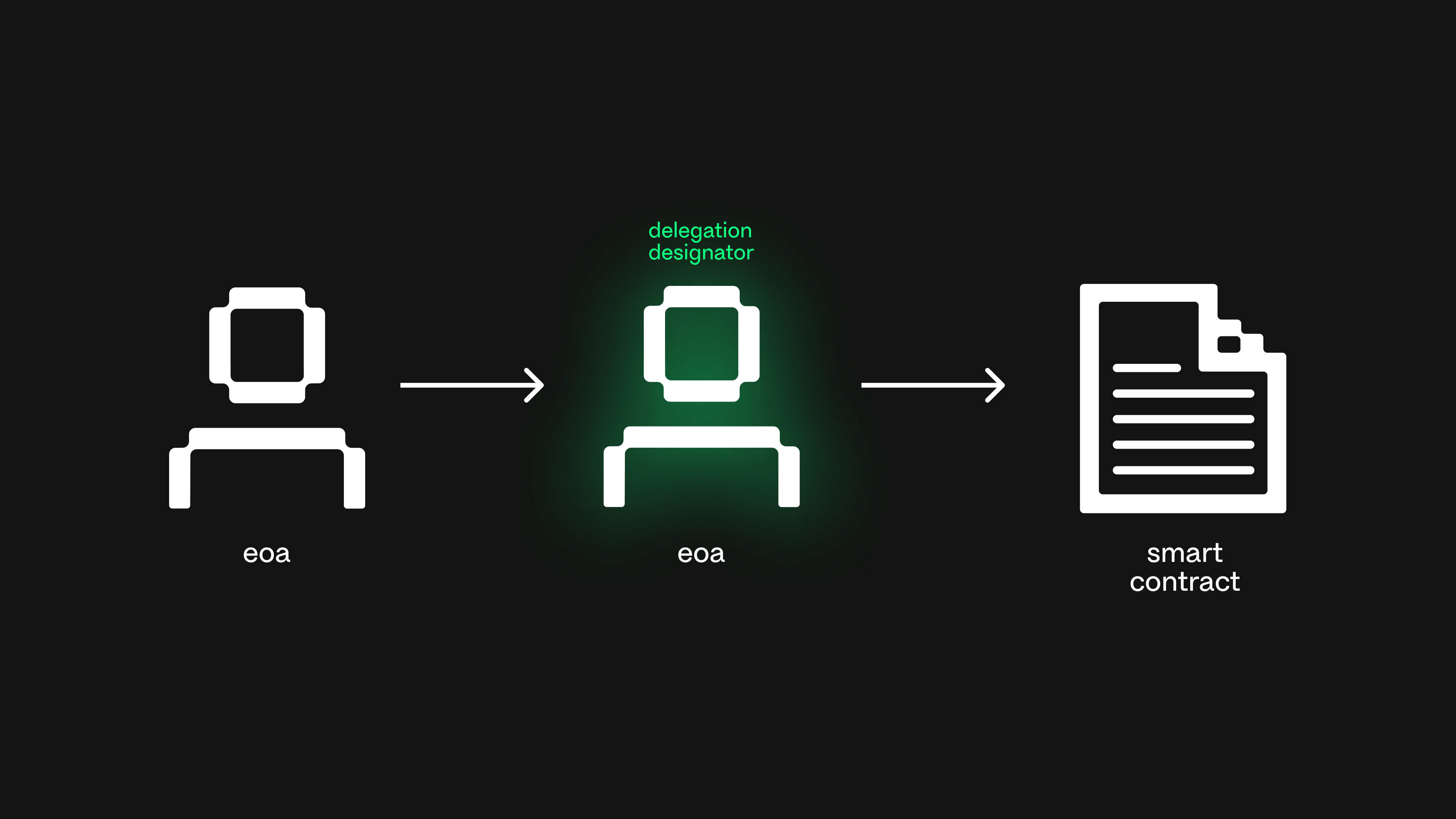
What EIP-7702 changes for Layer 2 users
EIP-7702, activated on the Ethereum mainnet with the Pectra upgrade in May 2025, fundamentally alters how Externally Owned Accounts (EOAs) interact with the network. Previously, if you wanted to use a smart contract wallet for features like gas sponsorship or transaction batching, you had to migrate your funds to a new address entirely. That process was often friction-heavy, requiring users to bridge assets, update their contact lists, and re-authorize dApp connections.
This upgrade changes that dynamic by allowing EOAs to temporarily delegate their execution power to a smart contract. Instead of moving your funds, you sign an authorization message that links your existing EOA to a smart account interface. For Layer 2 ecosystems, this is a significant shift because it enables sponsored transactions without forcing users to abandon their familiar wallet addresses. The EOA retains its simplicity for daily use while gaining the programmability of a smart contract when needed.
This capability bridges the gap between the ease of use of standard wallets and the advanced features of account abstraction. Users can now benefit from gas sponsorship—where a third party pays the transaction fee—directly from their primary EOA. This reduces the barrier to entry for new users who might be intimidated by the concept of smart accounts, while still providing the infrastructure Layer 2s need to offer seamless, gas-free experiences.
The implementation relies on a new transaction type that records these authorizations on-chain. When a user interacts with a dApp that supports this feature, the smart contract can execute actions on their behalf, effectively turning a standard wallet into a smart account for that session. This means Layer 2s can offer sponsored transactions and complex batching features to the vast majority of users who have never touched a smart contract wallet before.
By removing the need for address migration, EIP-7702 accelerates the adoption of account abstraction features across Layer 2s. It allows developers to build sponsored transaction flows that work seamlessly with the wallets users already have, making the underlying blockchain technology less visible and the user experience more intuitive.
ERC-4337 vs EIP-7702: Architecture and UX
Choosing between ERC-4337 and EIP-7702 comes down to a fundamental trade-off: do you prioritize immediate, permissionless deployment or native protocol efficiency? ERC-4337 operates as a userland standard, allowing developers to deploy smart contract wallets without waiting for network upgrades. EIP-7702, activated during the Pectra upgrade, modifies the Ethereum protocol itself to allow Externally Owned Accounts (EOAs) to temporarily delegate execution to smart contracts.
Architecture Differences
ERC-4337 introduces a new mempool entry point and relies on a decentralized network of "bunders" to package and submit transactions. This architecture requires a Paymaster contract to sponsor gas fees, enabling users to pay with tokens other than ETH. However, this flexibility adds complexity; users must interact with a smart contract account rather than their standard key pair.
EIP-7702 takes a different approach by updating the EOA itself. It introduces a new transaction type with an "authorizations" field. When a user signs this authorization, their EOA temporarily behaves like a smart contract for that specific transaction. This means the transaction is processed natively by the Ethereum Virtual Machine (EVM), eliminating the need for external bundlers for basic execution.
User Migration and Experience
The user experience gap is narrowing, but the paths differ significantly. With ERC-4337, users often need to migrate to a new wallet address or use a "session key" flow that abstracts the underlying smart contract. This can be confusing for non-technical users who are accustomed to managing a single private key.
EIP-7702 requires no migration. Your existing EOA address remains the same, but it gains smart wallet capabilities on demand. This "zero-migration" approach lowers the barrier to entry, as users do not need to move funds or learn new address formats. The delegation is temporary and revocable, maintaining the security model familiar to EOA users while offering the features of a smart account.
Gas Sponsorship and Costs
| Feature | ERC-4337 | EIP-7702 |
|---|---|---|
| Implementation | Userland standard (no protocol upgrade) | Protocol upgrade (Pectra) |
| Account Type | Smart Contract Account | EOA with delegation |
| Bundler Required | Yes (for transaction submission) | No (native inclusion) |
| Gas Sponsorship | Via Paymaster contracts | Via Paymaster or native fees |
| User Migration | Often requires new address | None (EOA remains same) |
ERC-4337's Paymaster mechanism is highly flexible, allowing for complex sponsorship logic like gasless transactions for specific dApps. EIP-7702 also supports Paymasters but integrates them more tightly with the native transaction lifecycle, potentially reducing overhead for simple sponsored transactions.
| Feature | ERC-4337 | EIP-7702 |
|---|---|---|
| Deployment | Permissionless smart contract | Protocol upgrade required |
| Bundler | Required | Not required |
| User Migration | Often needed | None |
| Gas Payment | Any token (via Paymaster) | ETH or any token (via Paymaster) |
Which Path Should You Choose?
For Layer 2s and applications prioritizing rapid adoption and existing infrastructure, ERC-4337 remains a robust choice. Its permissionless nature allows for immediate experimentation without waiting for network-wide consensus. However, for projects seeking the lowest possible gas costs and the simplest user onboarding, EIP-7702 offers a more streamlined path by leveraging the native EVM.
Why Layer 2s prefer EIP-7702 for gasless txs
Layer 2 networks are prioritizing EIP-7702 because it removes the friction of account migration while unlocking sophisticated gas sponsorship. Unlike ERC-4337, which requires users to deploy new smart contract wallets, EIP-7702 allows existing Externally Owned Accounts (EOAs) to temporarily delegate execution to smart contracts. This means L2s can offer account abstraction features without forcing their user base to abandon their familiar key-based wallets.
The technical advantage for L2s is significant. EIP-7702 introduces a new transaction type with an "authorizations" field, allowing users to sign a message that delegates execution to a smart contract. This delegation is recorded on-chain, enabling the L2 to sponsor the gas fees for that specific transaction. This approach avoids the complex bundler infrastructure required by ERC-4337, reducing operational overhead and lowering the gas cost for the end user.
The user experience benefit is immediate. Existing EOA holders can interact with L2 applications as if they were using smart accounts, with gas fees paid by the application or a relayer. This seamless transition encourages adoption by removing the learning curve associated with new wallet types. L2s can thus offer a superior, gasless experience while maintaining the simplicity and security of EOAs.
| Feature | EIP-7702 | ERC-4337 |
|---|---|---|
| Account Type | EOA with delegation | Smart Contract Wallet |
| Infrastructure | Protocol-level support | Bundler/Paymaster network |
| User Migration | No migration needed | Requires new wallet deployment |
Implementing EIP-7702 Sponsored Transactions
Integrating EIP-7702 allows wallet developers to offer sponsored transactions without forcing users to migrate to new account structures. The upgrade, live on mainnet via the Pectra release, enables Externally Owned Accounts (EOAs) to temporarily delegate execution to smart contracts. This capability bridges the gap between traditional wallets and account abstraction, letting Layer 2s and dApps pay gas fees on behalf of users while maintaining the security of the underlying EOA.
1. Set Up Authorization Signatures
The foundation of EIP-7702 is the authorization signature. Developers must implement the new transaction type that includes an authorizations field. When a user initiates a sponsored transaction, the wallet generates a signed authorization message. This message grants a specific smart contract (the paymaster) the right to execute a transaction on the user's behalf. The wallet must ensure the signature is valid and includes the necessary parameters, such as the target contract address and expiration time, before broadcasting the transaction to the network.
2. Integrate Paymaster Logic
With the authorization in place, the next step is connecting to a paymaster service. The paymaster receives the signed authorization and verifies that the EOA has indeed delegated permission to it. Once verified, the paymaster covers the gas costs for the transaction. Wallet developers should integrate with reliable paymaster providers that support EIP-7702, ensuring the service can handle the specific chain and L2 environment where the transaction occurs. This integration allows the user to remain in their familiar EOA interface while benefiting from gasless interactions.
3. Handle Delegation Revocation
Security requires a clear path to revoke delegated powers. EIP-7702 authorizations are temporary; they expire or can be revoked by the user at any time. Developers must provide a UI mechanism for users to revoke these delegations, effectively nullifying the smart contract's ability to act on their behalf. This is typically done by sending a transaction that resets the EOA's code to its original state. Implementing this revocation flow is critical for maintaining user trust and ensuring that compromised or outdated authorizations do not pose a long-term risk.
4. Test Across L2 Environments
Finally, rigorous testing is essential before deployment. Since EIP-7702 interacts with the core Ethereum protocol, its behavior may vary across different Layer 2 networks depending on their EVM compatibility and sequencing rules. Developers should test the full flow—authorization, sponsorship, and revocation—on target L2s to ensure compatibility. This includes verifying that the paymaster can correctly process the new transaction type and that the revocation process works as expected in each environment.
No comments yet. Be the first to share your thoughts!