
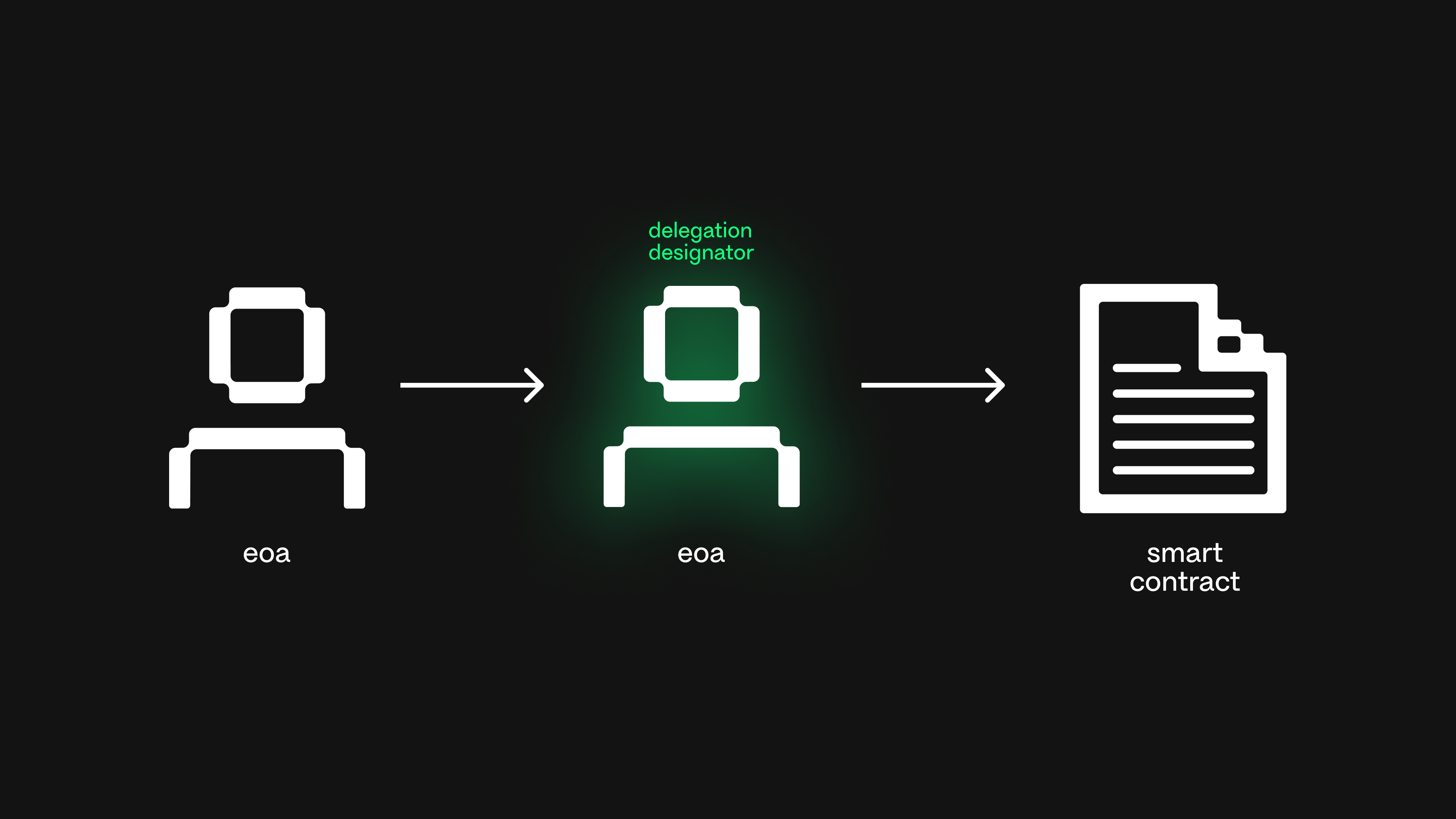
EIP-7702 migration limits to account for
EIP-7702 is live on Ethereum mainnet via the Pectra upgrade, allowing Externally Owned Accounts (EOAs) to temporarily delegate execution to smart contracts without changing addresses or moving assets. This hybrid model gives traditional wallets access to smart account features like session keys and gas sponsorship while maintaining familiar security models.
For enterprises, the decision to adopt EIP-7702 hinges on balancing immediate UX improvements against integration complexity. Unlike ERC-4337, which requires new smart account infrastructure, EIP-7702 works directly on the base layer. Below is a practical comparison to guide your decision based on your current architecture.
Comparison of Migration Approaches
The table below contrasts EIP-7702 with traditional ERC-4337 smart accounts and legacy EOAs. Understanding these distinctions helps teams select the right path for their specific use cases.
Tradeoffs by Use Case
The decision to adopt EIP-7702 depends heavily on your current architecture and user experience goals. Each approach carries distinct advantages and limitations that impact development and operational costs.
Existing EOA Holders
For enterprises managing large volumes of standard EOAs, EIP-7702 offers a low-friction upgrade path. Users can sign a single authorization to delegate to a smart contract implementation, enabling features like gas sponsorship and transaction batching without leaving their current wallet. This is particularly valuable for platforms that cannot force user migration.
New User Onboarding
If you are building a new product, ERC-4337 smart accounts may provide a more robust foundation. They offer persistent smart contract logic and native support for paymasters, which simplifies gas-free onboarding. EIP-7702’s delegated model is temporary and resets on certain conditions, which may complicate long-term account state management for new users.
High-Frequency Trading
For high-frequency or institutional use cases, EIP-7702’s ability to batch transactions and delegate execution can significantly reduce gas costs and improve throughput. However, the reliance on a delegated contract introduces a single point of failure if the contract is compromised. ERC-4337 accounts, while more complex to implement, offer greater control over security policies and multi-signature requirements.
Choose the next step
Enterprises must decide whether to integrate EIP-7702 now or wait for broader ecosystem support. The choice depends on your current infrastructure and risk tolerance. Below is a practical comparison to guide your decision.
EIP-7702 vs. ERC-4337
| Feature | EIP-7702 (EOA Delegation) | ERC-4337 (Smart Accounts) |
|---|---|---|
| Account Type | Existing EOAs gain smart capabilities | New smart contract accounts only |
| Infrastructure | Requires protocol upgrade (Pectra) | Relayer/Bundler network only |
| User Experience | Native wallet support (MetaMask, etc.) | Requires wallet abstraction layer |
| Migration | No address change required | New address generation required |
| Complexity | Moderate (new transaction type) | High (bundlers, paymasters) |
Decision Framework
Choose EIP-7702 if:
- You need to onboard existing users without forcing them to create new wallet addresses.
- Your primary goal is reducing transaction costs through session keys and sponsored gas.
- You can support the Pectra upgrade timeline and require native wallet compatibility.
Stick with ERC-4337 if:
- You are building a greenfield application and want full control over account logic from day one.
- You need advanced features like social recovery or multi-sig that EIP-7702 does not natively support.
- You prefer a solution that works on older Ethereum networks without waiting for protocol upgrades.
Implementation Checklist
-
Audit current wallet integrations for Pectra compatibility.
-
Test EIP-7702 authorization signatures on testnet.
-
Evaluate bundler providers if hybrid support is needed.
-
Update user documentation for new delegation flows.
-
Monitor gas cost trends for authorization transactions.
Spotting Weak EIP-7702 Claims
Many vendors claim EIP-7702 is a "drop-in" upgrade for enterprise wallets. This is misleading. EIP-7702 does not change the EOA address or require migration; it allows an EOA to temporarily delegate execution to a smart contract via a signed authorization.
The real difference lies in architecture. ERC-4337 requires a new smart account infrastructure and bundlers. EIP-7702 works directly on the base layer, enabling EOAs to act like smart accounts without changing the address. This distinction matters for compliance teams auditing transaction origins.
Watch for "zero-cost" migration claims. While no new wallet is needed, integrating EIP-7702 requires updating signature verification logic to handle the new 0x63 prefix. If a provider claims no code changes are needed, they are likely ignoring the authorization delegation step.
Comparison: EIP-4337 vs. EIP-7702
| Feature | ERC-4337 (Account Abstraction) | EIP-7702 (Set Code for EOAs) |
|---|---|---|
| Account Type | New Smart Account (Contract) | Existing EOA (Externally Owned Account) |
| Infrastructure | Requires Bundlers & Paymasters | Native to Ethereum Base Layer |
| Migration | Must deploy new contract | No migration; uses existing address |
| Signature | Custom validation logic | Standard ECDSA + Authorization |
| Enterprise Fit | High flexibility, complex ops | Lower friction, familiar security model |
Decision Guide
Choose ERC-4337 if you need advanced features like paymasters or session keys that operate independently of the base transaction. Choose EIP-7702 if you want to bring smart account capabilities to your existing EOA infrastructure without managing new contract deployments or bundler relationships. For most enterprises prioritizing simplicity and existing compliance frameworks, EIP-7702 offers a more direct path.
EIP-7702 migration: what to check next
Enterprises often pause on account abstraction due to uncertainty about deployment timelines and technical integration. EIP-7702 is live on Ethereum mainnet as part of the Pectra upgrade. It enables EOAs to delegate execution to smart contracts without migrating addresses or transferring assets.
Is EIP-7702 implemented?
Yes. EIP-7702 was activated as part of the Ethereum Pectra upgrade on mainnet. It is fully operational and supported by major wallets like MetaMask and Rabby, which now handle the new 0x63 authorization type.
What are EIP-7702 authorizations?
EIP-7702 authorizations are signed messages that allow an EOA to temporarily set its code to a smart contract address. This signature, typically using the 0x63 prefix, grants the designated contract the ability to execute transactions on behalf of the EOA for a specific session or until revoked. It does not transfer ownership or permanently alter the account.
What is the difference between EIP 4337 and EIP-7702?
EIP-4337 (Account Abstraction) introduces a new account type (smart contracts) that operates outside the base transaction lifecycle, requiring a separate network of bundlers and paymasters. EIP-7702 enhances existing EOAs by allowing them to temporarily delegate execution to smart contracts while remaining native to the base layer. EIP-7702 requires no new infrastructure beyond the protocol upgrade, whereas EIP-4337 requires integrating bundler services.
What is the EIP-7702 prefix?
The EIP-7702 authorization uses the 0x63 prefix in signature verification. This distinguishes the new authorization type from standard ECDSA signatures (0x1c, 0x1b, 0x00). Wallets and nodes must recognize this prefix to validate that an EOA has delegated execution to a smart contract.
No comments yet. Be the first to share your thoughts!