
No migration required for users
The term "migration" often triggers anxiety in crypto, but for Ethereum’s EIP-7702, it is a misnomer for end users. You do not need to move your funds, change your wallet address, or perform any on-chain transfer to benefit from this upgrade. EIP-7702 is a code-level protocol change, not a migration event that requires asset relocation.
EIP-7702 introduces a new transaction type that allows Externally Owned Accounts (EOAs) to temporarily set code in their account, enabling smart contract functionality without permanently converting your wallet into a smart contract account [[src-serp-8]]. This means your existing wallet address remains fully compatible. The upgrade works beneath the surface, allowing your wallet software to interpret and sign these new transaction types seamlessly.
Note: The word "migration" in this context refers to wallet providers updating their software to support the new EIP-7702 specification, not users migrating their assets. Your funds stay exactly where they are.
Think of EIP-7702 like a software update for your operating system. You don’t need to buy a new computer or move your files to a different drive to get the new features; the existing hardware just gains new capabilities through the updated code. Similarly, your Ethereum address remains the same, but it can now interact with more advanced smart contract features when you choose to use a compatible wallet.
There is no permanent migration or forced conversion. Your EOA retains its standard identity while gaining the ability to leverage account abstraction features when needed. This approach ensures that the upgrade is non-disruptive and maintains backward compatibility with all existing Ethereum infrastructure.
How accounts delegate to smart contracts
The mechanism allows an externally owned account to designate a smart contract as its implementation. This bridges the gap between simple key-controlled accounts and complex smart contract wallets without requiring a permanent migration. Instead of moving assets, the account temporarily borrows the logic of a smart contract.
The process begins with a signed authorization. When an owner wants to use smart contract features, they sign a specific authorization code using their private key. This signature is not a transfer of funds but a permission slip. It tells the Ethereum network that this specific account agrees to execute code stored in a designated contract address for that session.
Once the network validates the signature, the account’s code is effectively swapped out for the contract’s logic during the transaction execution. The private key remains the sole source of control; the authorization is just a temporary delegation. When the transaction completes, the account reverts to its standard state. This design ensures that users never lose custody of their assets or expose their private keys to a third-party smart contract.
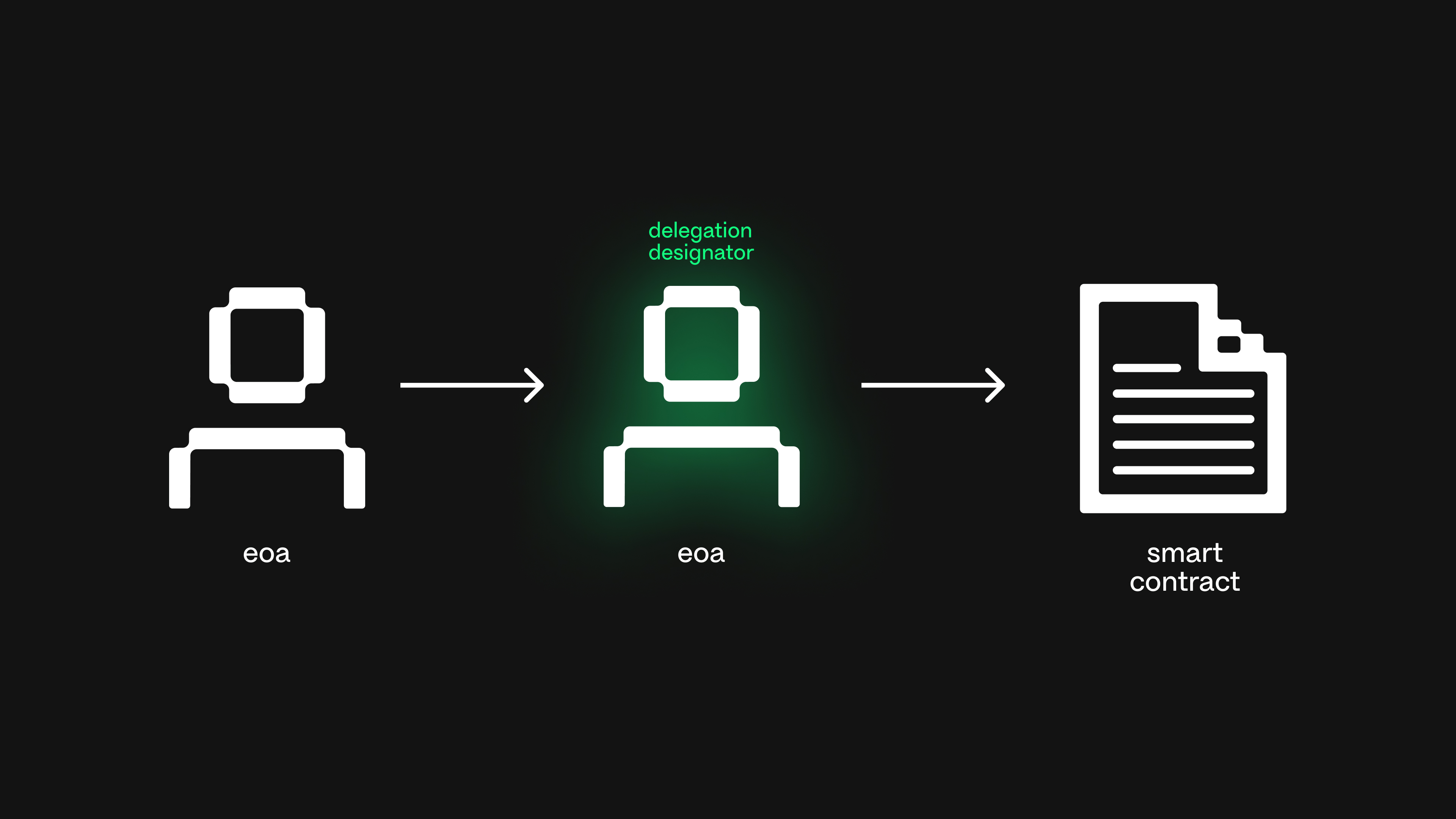
This architecture preserves the simplicity and security of standard accounts while unlocking the programmability of smart accounts. Users can leverage features like account abstraction, session keys, or multi-signature logic without the complexity of deploying and managing a new contract address.
EIP-7702 versus ERC-4337 and 3074
To understand why EIP-7702 was selected for the Pectra upgrade, it helps to look at the three main approaches to account abstraction that reached consensus level. Each proposal offers a different path to smart wallet functionality, balancing security, complexity, and user experience. EIP-7702 stands out by allowing Ethereum accounts to delegate authority to smart contracts without changing the underlying address or requiring users to migrate their funds.
This approach contrasts sharply with ERC-4337, which introduced a separate entry point contract and required a new transaction type. While ERC-4337 is already live on many chains, it demands significant infrastructure changes for exchanges and dApps. EIP-3074, an earlier proposal, aimed to add raw opcode support for account abstraction but faced security concerns and complexity that stalled its progress. EIP-7702 offers a middle ground: it leverages the existing account infrastructure while unlocking smart contract capabilities.
The table below compares the core differences across these three standards.
| Standard | Migration Needed | Gas Cost | Security Model |
|---|---|---|---|
| EIP-7702 | No | Low (native) | Delegation-based |
| ERC-4337 | Yes (new wallet) | Higher (entry point) | Sandboxed |
| EIP-3074 | No | Low (native) | Opcode-based |
EIP-7702’s primary advantage is its backward compatibility. Users keep their existing addresses and private keys, which removes the biggest barrier to adoption: the fear of losing funds during a migration. ERC-4337, while robust, requires users to create new smart contract wallets, a process that can feel foreign to newcomers. EIP-3074’s opcode approach, though efficient, introduced potential attack vectors that made it less attractive to auditors and developers.
For the Pectra upgrade, the trade-off favored EIP-7702 because it minimizes disruption. It allows developers to build smart wallets on top of existing accounts, creating a smoother transition for mainstream users. This approach aligns with the broader goal of making Ethereum more accessible without sacrificing the security guarantees that users trust.
Wallet provider implementation checklist
The Pectra upgrade introduces EIP-7702, fundamentally changing how Ethereum handles account types. For wallet developers and dApp integrators, this means updating core infrastructure to recognize and process the new transaction type. The goal is to allow externally owned accounts to temporarily delegate their signing authority to smart contracts without requiring users to migrate their addresses.
Failure to support this new transaction format will result in dropped transactions or failed interactions with upgraded contracts. Below is the technical checklist for ensuring your wallet is ready for the EIP-7702 migration.
type 4
transaction. Standard JSON-RPC methods like
eth_sendRawTransaction
must now validate and relay these specific transaction formats. If your node software is outdated, it will reject valid EIP-7702 transactions as malformed. Ensure your development environment uses the latest versions of libraries like viem or ethers.js, which have native support for parsing and signing these new structures.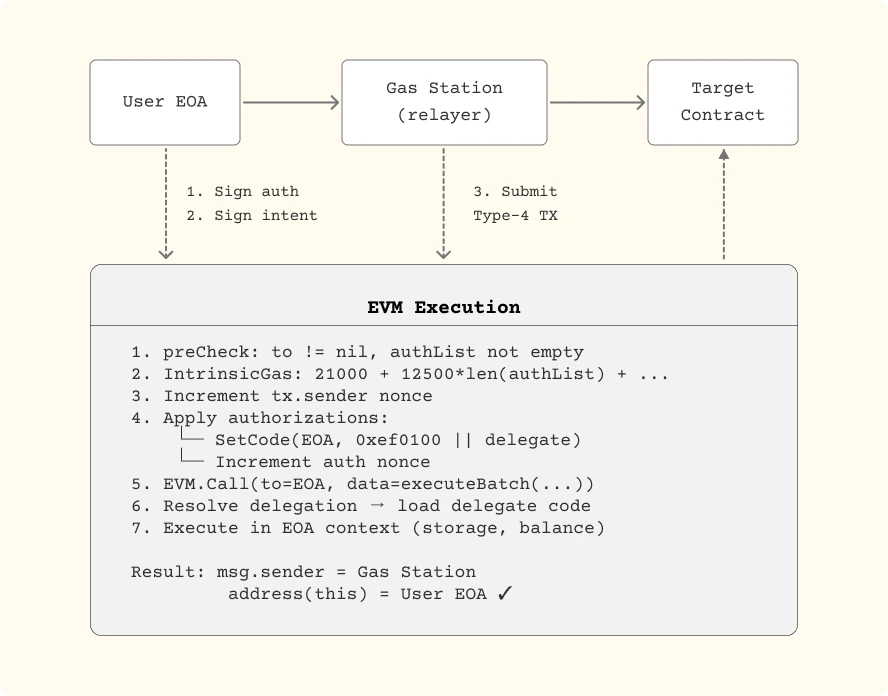
authorizationList
within the transaction payload. Incorrect validation can lead to unauthorized delegation or rejected transactions. Test your implementation against the official Ethereum test vectors to ensure cryptographic correctness.
| Component | Action Required | Risk if Ignored |
|---|---|---|
| RPC Client | Upgrade to Pectra-compatible version | Transaction rejection |
| Signature Validator | Implement type 4 validation | Security vulnerability |
| User Interface | Display delegation details | Phishing/Unauthorized access |
Testing is critical before the mainnet activation. Use the Ethereum Pectra testnet to simulate real-world scenarios where users interact with smart contracts via their accounts. Monitor gas usage and transaction success rates to identify any edge cases in your implementation. For developers, the viem documentation provides a comprehensive overview of the technical changes required for EIP-7702 integration.
Risks and limitations of delegation
EIP-7702 introduces a powerful delegation mechanism, but it is not a direct migration to full Account Abstraction. Instead, it serves as a forward-compatible foundation that requires careful management of smart contract wallets. Users must understand that delegating authority to a contract wallet does not eliminate the complexity of recovery mechanisms; it shifts the burden of security to the contract's logic.
A primary concern is the revocation process. While you can revoke delegation, doing so requires a specific transaction from the externally owned account. If your private keys are lost or your device is compromised before you can execute this revocation, the delegated contract retains control. This creates a window of vulnerability where an attacker with access to your account can exploit the delegated permissions.
Recovery for smart contract wallets under EIP-7702 is more complex than standard accounts. Because the wallet's logic is embedded in the contract code, standard recovery tools may not work. You must rely on the specific recovery mechanisms defined by the wallet provider, such as social recovery or multi-sig setups. If these are not configured correctly, losing access to the account could mean losing access to the assets permanently.
The trade-off between flexibility and security is inherent in this upgrade. While EIP-7702 enables more sophisticated wallet functionalities, it demands a higher level of technical awareness from users. Ignoring the limitations of delegation and recovery can lead to significant financial loss, making it essential to understand the specific risks before migrating.
Common questions about EIP-7702
Do I need to move my funds to use EIP-7702? No. There is no permanent migration. EIP-7702 explicitly avoids requiring users to migrate funds or change wallets. Your assets remain in your existing wallet, and the upgrade allows your Ethereum Account to temporarily act like a smart contract when needed.
Will gas fees be cheaper? Gas costs depend on how you use the feature. Setting up a delegation involves a one-time transaction cost. However, because EIP-7702 allows accounts to batch operations, you can save on gas by combining multiple actions into a single transaction, reducing the overall cost per interaction.
Is EIP-7702 safe for my wallet? The security model relies on delegation. Your private key remains in your wallet, and you only sign transactions when you want to activate smart account features. This means you retain full control, and you can revoke the delegation at any time to return to standard account functionality.
No comments yet. Be the first to share your thoughts!