
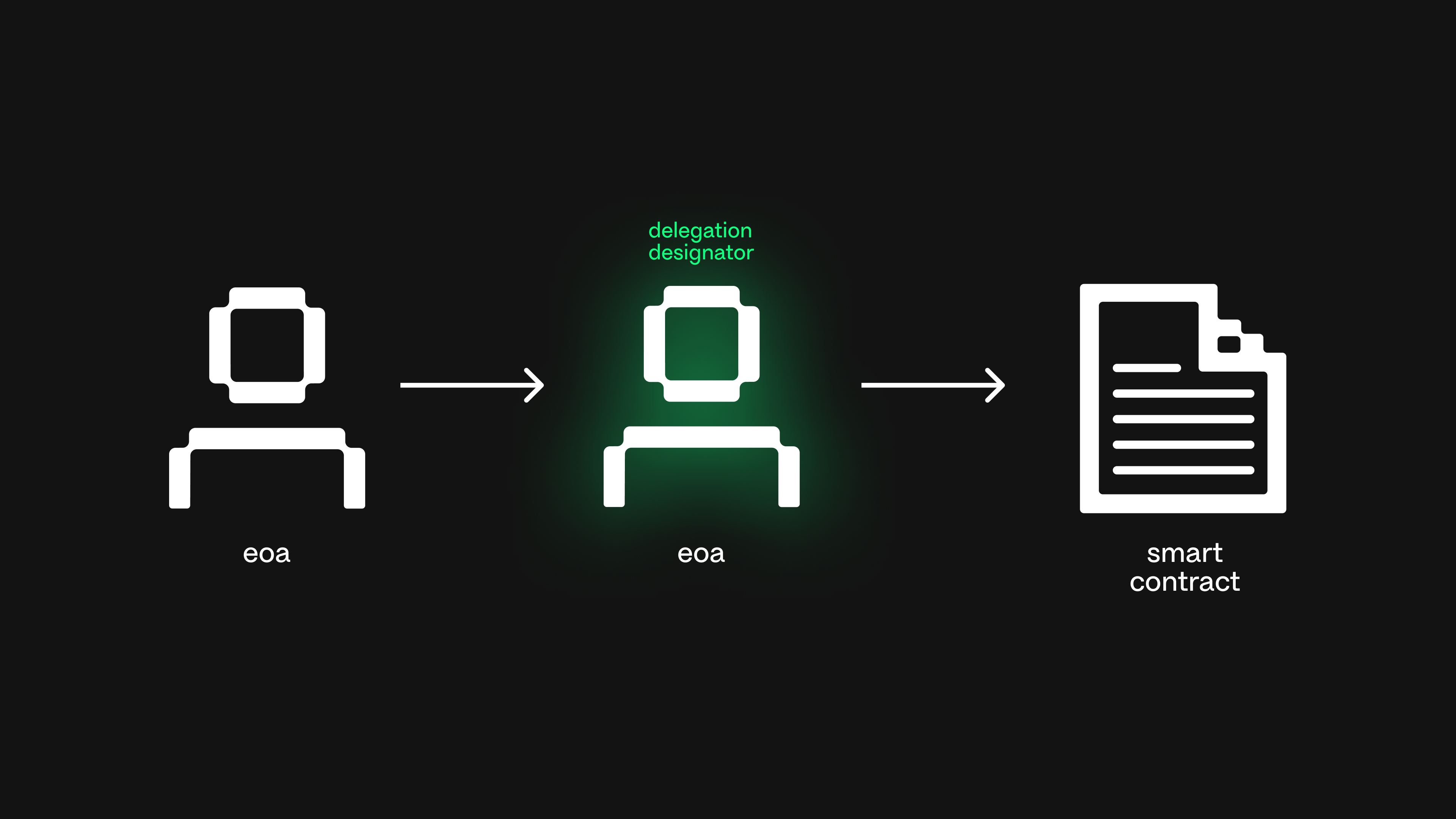
What EIP-7702 changes for legacy contracts
EIP-7702 does not require a full migration of legacy smart contracts. Instead, it introduces a new delegation mechanism for Externally Owned Accounts (EOAs), fundamentally altering how dapps interact with user accounts. This upgrade allows existing addresses to temporarily execute smart contract code without changing the underlying address or forcing a costly migration to a new wallet standard.
How delegation replaces migration
Under the current Ethereum model, EOAs are simple key pairs that cannot hold code or storage. Smart contract wallets, which offer features like gas sponsorship and session keys, require users to migrate their funds to a new address. EIP-7702 bridges this gap by allowing an EOA to delegate its execution rights to a smart contract for a specific period.
When a user signs an authorization message, the network records this delegation. The EOA retains its original address, but its transactions can now trigger smart contract logic. This means developers can integrate advanced account abstraction features—such as batched transactions or paymaster sponsorship—into existing wallets without requiring users to abandon their legacy addresses. The result is a smoother upgrade path where the user experience improves without the friction of account migration.
Implications for dapp compatibility
For dapp developers, this shift means rethinking how account interactions are validated. Traditional checks that assume an EOA is purely a key pair must now account for the possibility that the account is delegating to a smart contract. Tools and libraries need to be updated to recognize the new transaction type and the associated authorization signatures.
This change also impacts how gas is handled. Since the delegated contract can execute arbitrary code, it can potentially pay for gas on behalf of the user or batch multiple operations into a single transaction. This flexibility reduces the complexity for end users but requires dapps to handle more complex transaction structures. Compatibility updates are essential to ensure that existing smart contracts continue to function correctly alongside these new delegation patterns.
Comparing EIP-7702 with ERC-4337
The choice between EIP-7702 and ERC-4337 defines the architecture of your decentralized application. EIP-7702 introduces protocol-level delegation, allowing standard Externally Owned Accounts (EOAs) to temporarily execute smart contract code. This approach upgrades the existing wallet infrastructure without requiring users to migrate to new addresses. ERC-4337, by contrast, operates at the application layer, relying on a separate mempool and bundlers to process user operations. It treats every account as a smart contract from the start.
Your decision should depend on your target audience and technical constraints. EIP-7702 offers immediate compatibility with millions of existing wallets, making it ideal for applications that prioritize broad accessibility. ERC-4337 provides deeper customization and gas sponsorship capabilities but requires users to adopt smart contract wallets or rely on account recovery services.
| Feature | EIP-7702 | ERC-4337 |
|---|---|---|
| Implementation Layer | Protocol-level (L1) | Application-layer |
| Wallet Requirement | Existing EOAs | Smart Contract Wallets |
| Migration Needed | No | Yes |
| Gas Sponsorship | Limited (session keys) | Native (paymasters) |
| Bundler Dependency | No | Yes |
Gas optimization benefits of delegation
EIP-7702 fundamentally changes the economics of transaction execution by allowing Externally Owned Accounts (EOAs) to delegate their execution logic to smart contracts. This capability enables a form of transaction batching that was previously impossible for standard wallets. Instead of signing and paying for each individual interaction with a decentralized application, users can group multiple actions into a single batch. This reduces the per-action gas overhead, making complex workflows significantly cheaper.
The mechanism works by attaching an "authorization" field to transactions. When a user signs this authorization, they grant a smart contract the permission to execute specific code on their behalf. This effectively turns a standard wallet into a temporary smart contract account for the duration of the transaction. The gas savings come from eliminating redundant signature verification and storage operations that would otherwise occur if each step were executed as a separate transaction.
Session keys further enhance these savings by allowing temporary, limited-purpose access to the wallet. Instead of requiring a full user signature for every single interaction within a session, the dapp can use a pre-approved key. This reduces the computational load on the network and allows for smoother, more responsive user experiences, particularly in high-frequency trading or gaming environments where latency and cost are critical.
To understand the real-world impact, consider the current cost of interacting with Ethereum. A live view of ETH prices helps contextualize these gas fees in USD terms, showing how even small savings per transaction can add up for active users.
The financial advantage is clear: by batching operations and using session keys, dapps built on EIP-7702 can offer lower fees than those relying on traditional EOA interactions. This makes them more competitive in 2026, where user expectations for low-cost, high-speed transactions are rising. As the ecosystem matures, applications that leverage these delegation features will likely see higher adoption rates due to their superior economic efficiency.
Wallet support and migration steps
EIP-7702 eliminates the need for a full wallet migration. Instead of forcing users to move funds to a new smart contract address, the protocol allows an Externally Owned Account (EOA) to delegate execution rights to a smart contract temporarily. This means your existing wallet infrastructure remains intact, but you gain access to account abstraction features like gas sponsorship and session keys.
To implement this, developers must guide users through a specific authorization signature flow. The process relies on a special transaction type that includes an "authorizations" field. When a user signs this authorization, the Ethereum network records the delegation, linking their EOA to the smart contract logic. This mechanism is the core of the EIP-7702 migration, enabling seamless upgrades without address changes.
Verify wallet compatibility
Before implementing the signature flow, confirm that the target wallets support the EIP-7702 transaction type. Wallet compatibility varies by provider and version. Check official documentation for major wallets like Safe or MetaMask to ensure they can parse and broadcast the new authorization transactions. If a wallet does not support the signature format, the delegation will fail.
Generate the authorization signature
The user must sign a specific authorization message. This message includes the chain_id, the address of the smart contract to delegate to, and the current nonce of the EOA. The signature proves ownership of the EOA and grants permission to the contract. Ensure your backend or frontend library correctly hashes and formats this data according to the EIP-7702 specification.
Test the delegation flow
Deploy a test environment on a testnet that supports EIP-7702. Simulate the full flow: user signs the authorization, broadcasts the transaction, and verifies that the smart contract can now execute on behalf of the EOA. Check that the nonce is incremented correctly and that the delegation persists across multiple transactions. This step is critical to avoid failed transactions in production.
Monitor and update
Once live, monitor transaction success rates. If users encounter errors, check if their wallet versions need updating. Provide clear error messages if a wallet does not support the new signature format. Keep documentation updated as wallet implementations evolve.
No comments yet. Be the first to share your thoughts!