
What EIP-7702 Changes for EOAs
EIP-7702 introduces a delegation mechanism that allows Externally Owned Accounts (EOAs) to execute smart contract logic without migrating to a full Account Abstraction (ERC-4337) model. This upgrade effectively grants legacy Ethereum accounts the ability to hold code and storage, bridging the gap between simple key-based ownership and programmable smart contracts.
The core innovation lies in the SETCODE transaction type. Instead of deploying a contract at an EOA address, the owner signs a specific authorization that delegates execution rights to a pre-existing smart contract. This delegation is temporary and revocable, allowing the EOA to retain its primary identity while leveraging smart contract features like batched transactions, paymasters, or multi-signature logic on a per-transaction basis.
This approach avoids the complexity of full account abstraction migration. Users do not need to migrate their funds to a new wallet contract or change their private key management. Instead, the EOA remains the primary account, with smart contract capabilities activated only when the delegated transaction is submitted. This preserves the simplicity of EOAs while unlocking the flexibility of smart contracts.
The Pectra upgrade activates this functionality, marking a significant step toward a more programmable Ethereum network. By enabling EOAs to interact with smart contracts directly, EIP-7702 reduces friction for users and developers alike, setting the stage for broader adoption of account abstraction features in 2026.
Smart EOAs vs Full Account Abstraction
EIP-7702 introduces a delegation model that allows Externally Owned Accounts (EOAs) to sign a one-time authorization, linking their address to a smart contract. This mechanism enables legacy wallets to execute complex logic without migrating assets or changing addresses. In contrast, full Account Abstraction (AA), standardized by ERC-4337, requires a complete transition to a smart contract wallet address, offering deeper structural control over transaction validation and paymasters.
The choice between these models hinges on migration friction versus functional depth. Smart EOAs prioritize immediate compatibility and ease of adoption, making them a pragmatic upgrade for the existing user base. Full AA provides a more robust foundation for advanced features like session keys and social recovery but demands a steeper learning curve for users accustomed to traditional key management.
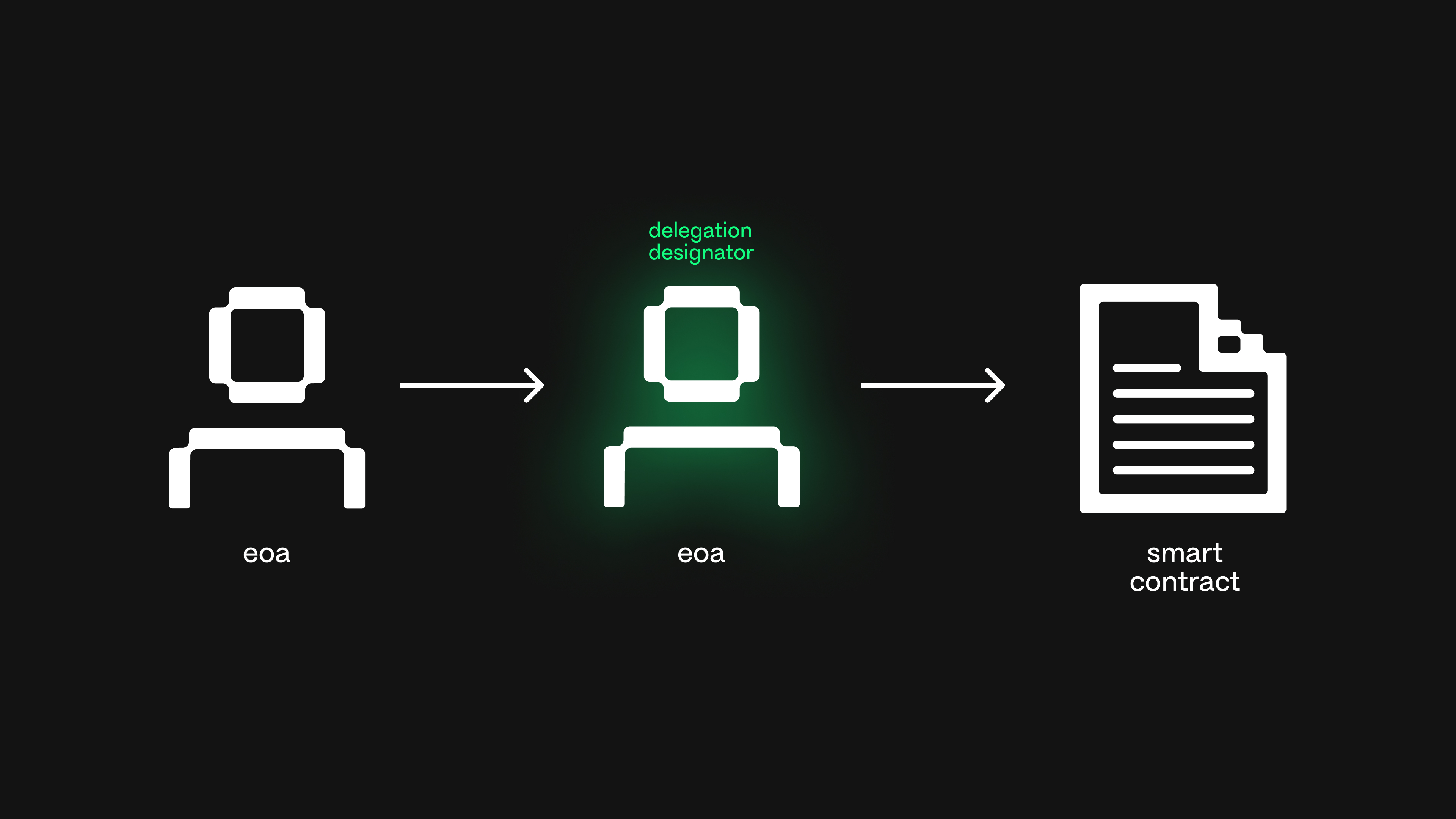
The following table outlines the technical distinctions between the two approaches, focusing on deployment requirements, gas implications, and supported capabilities.
| Feature | EIP-7702 Smart EOA | Full Account Abstraction |
|---|---|---|
| Migration Requirement | No asset transfer; in-place delegation | |
| Gas Costs | Higher init costs (CODECOPY), lower tx costs | |
| Session Keys | Limited (requires new delegation per contract) | |
| Social Recovery | Not supported natively | |
| User Experience | Seamless for existing wallets |
Gas Costs and Sponsorship in 2026
EIP-7702 fundamentally alters the economics of user onboarding by allowing externally owned accounts (EOAs) to temporarily delegate their authority to smart contracts. This mechanism, known as "account abstraction lite," enables gasless transactions through sponsorship models that were previously inaccessible to standard wallets. Instead of requiring users to hold native ETH for every interaction, sponsored transactions allow third parties—such as dApp developers or relayers—to pay the gas fees on behalf of the user.
The economic impact is measurable. For new users, the friction of acquiring and managing small amounts of ETH for gas is a significant barrier. By offloading this cost to the application layer, EIP-7702 reduces the effective cost of entry for non-technical users. This shifts the gas burden from the user to the service provider, aligning transaction costs with the value delivered by the application rather than the complexity of the underlying blockchain protocol.
However, this model introduces new risks and cost structures for sponsors. Relayers must manage the liquidity of their sponsorship pools and mitigate the risk of malicious or spam transactions. While the user experience improves, the economic sustainability of gas sponsorship depends on the efficiency of the underlying smart contract logic and the volatility of gas prices. Sponsors must carefully calibrate their limits to prevent abuse while maintaining a seamless experience for legitimate users.
Wallet Migration and Implementation
EIP-7702 introduces a paradigm shift where Externally Owned Accounts (EOAs) gain smart contract capabilities without requiring address migration. For wallet providers and decentralized applications (dApps), this means the user experience remains unchanged while the underlying verification logic must evolve. The primary benefit is the elimination of friction: users retain their existing private keys and addresses while accessing account abstraction features like session keys and paymasters.
Update Signature Verification Logic
Wallets must integrate the new EOA_DELEGATECODE opcode handling. Current signature verification mechanisms, which rely solely on ECDSA or Schnorr signatures against the EOAs code hash (which is currently zero), need to account for the new delegation state. When a transaction is submitted, the node checks if the EOA has delegated to a smart contract via EIP-7702. If so, the validation logic must execute the delegated code to verify the signature, rather than assuming a simple key-based verification. This requires updating the transaction pool and mempool policies to handle these new transaction types correctly.
Implement Delegation Signing Flows
The core of EIP-7702 is the delegation process, where an EOA signs a specific authorization message to link itself to a smart contract. Wallet interfaces must present this delegation clearly, ensuring users understand they are granting access to a specific contract for specific operations. The delegation signature must be included in the first transaction that interacts with the delegated contract. Wallets should guide users through this initial signing flow, often bundling the delegation authorization with the first intended action to minimize user interactions.
Test Against Pectra Testnet
Before mainnet deployment, all wallet infrastructure must be rigorously tested on the Pectra testnet. This involves simulating delegation scenarios, verifying gas cost calculations for EOA_DELEGATECODE execution, and ensuring compatibility with existing smart contract standards. Developers should focus on edge cases, such as re-delegation and revocation, to prevent potential security vulnerabilities or unexpected behavior during the transition period.
Review your wallet's transaction validation pipeline to identify hardcoded assumptions about EOA signatures. Map out where the new EOA_DELEGATECODE logic needs to be injected to support delegated accounts without breaking existing non-delegated transactions.
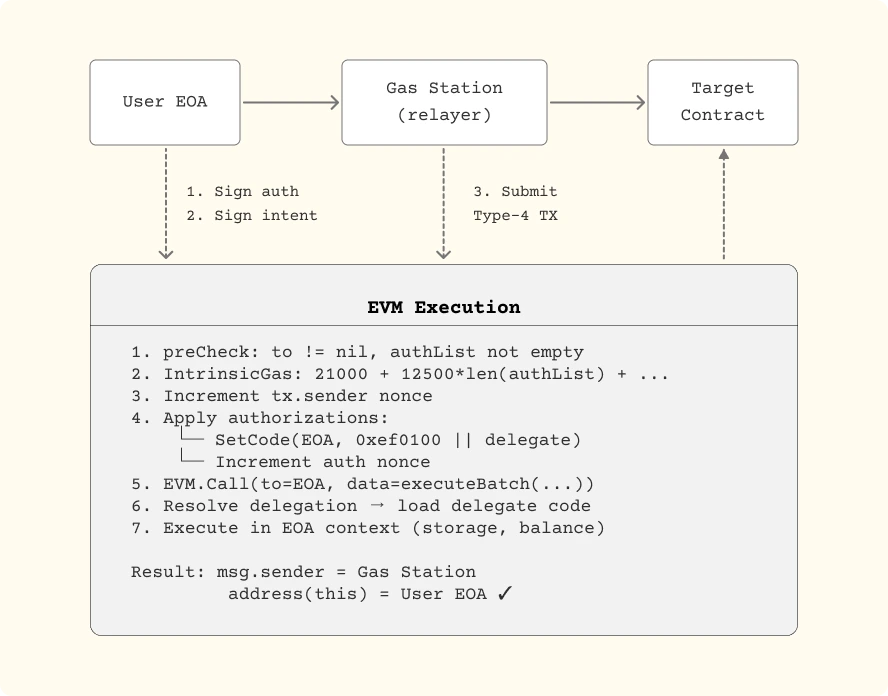
Add UI components and backend handlers for the EIP-7702 delegation signature. Ensure the authorization message is correctly formatted and signed, and that it is properly attached to the first transaction interacting with the delegated contract.
Deploy your updated wallet infrastructure to the Pectra testnet. Run comprehensive test suites covering delegation, execution, and revocation scenarios. Verify that gas estimation and transaction inclusion rates match mainnet expectations.
| Feature | Standard EOA | EIP-7702 Delegated |
|---|---|---|
| Address Migration | Not Required | Not Required |
| Signature Verification | ECDSA/Schnorr | Delegated Contract Code |
| Gas Optimization | Standard | Potential via Paymasters |
| Session Keys | Not Supported | Supported via Contract |
Common Questions on EIP-7702
Can I reverse EIP-7702 delegation?
You cannot immediately revoke delegation once signed. Ethereum.org notes that the only current method to undo EIP-7702 is to send a zero-value transaction from your EOA, which resets the delegation state. This acts as a manual "off switch" rather than an automatic expiration.
Do I need a new wallet to use it?
No asset transfers or address changes are required. As Openfort explains, EIP-7702 allows existing EOAs to delegate to smart contracts without migrating assets. Your current address remains the same, but its behavior changes to support batched transactions.
How does this affect gas fees?
Delegation introduces extra signature verification steps, which may slightly increase gas costs for individual transactions. However, the ability to batch operations often results in net savings for active users. The trade-off depends on your transaction volume and complexity.
No comments yet. Be the first to share your thoughts!