
EIP-7702 migration 2026 explained
EIP-7702, activated in the Pectra upgrade, introduces a temporary delegation mechanism that allows Externally Owned Accounts (EOAs) to behave like smart contracts without permanently migrating their code. This innovation addresses a long-standing limitation in Ethereum architecture: EOAs have always lacked the ability to store code or execute logic beyond simple signature verification. By enabling EOAs to delegate execution to smart contracts, EIP-7702 effectively grants them access to account abstraction features while maintaining their original private key control.
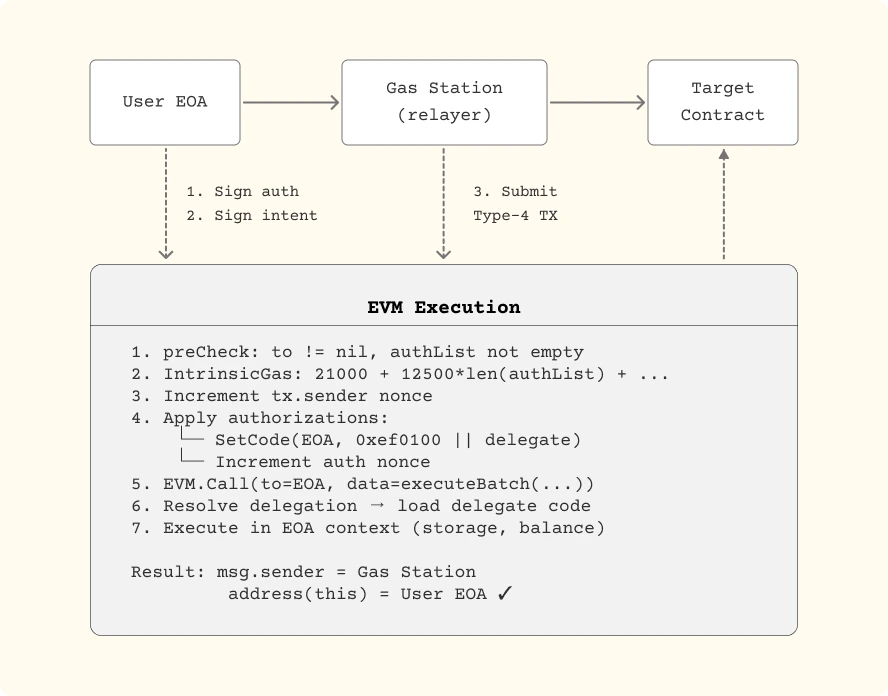
The mechanism works by allowing an EOA to sign a special transaction that associates its address with a specific smart contract's code. When the EOA sends a transaction, the Ethereum Virtual Machine (EVM) temporarily executes the delegated contract's code instead of the default EOA logic. This delegation is temporary and can be revoked by the account owner at any time by signing a new transaction that clears the delegation. This design ensures that users retain full sovereignty over their assets while gaining access to advanced functionality like batch transactions, session keys, or social recovery.
This approach offers a pragmatic path toward account abstraction adoption. Rather than forcing users to migrate to fully self-custodial smart contract wallets immediately, EIP-7702 allows incremental adoption. Users can experiment with abstraction features while keeping their familiar EOA interface. The migration is reversible, reducing the barrier to entry for users who might otherwise resist the complexity of smart contract wallet management. This flexibility is particularly valuable for mainstream adoption, as it allows wallets and applications to offer advanced features without requiring users to fundamentally change how they manage their keys.
The technical implementation of EIP-7702 involves specific changes to how the EVM processes transaction signatures and code execution. When an EOA with an active delegation sends a transaction, the EVM checks for the delegation record and executes the associated contract code. This process is transparent to the user and does not require any changes to existing wallet interfaces or transaction formats. The delegation state is stored on-chain, ensuring that it is persistent across different sessions and devices. This on-chain storage is crucial for maintaining the integrity of the delegation mechanism and ensuring that it cannot be tampered with by third parties.
Smart EOAs vs full smart accounts
The 2026 migration introduces two distinct paths for account abstraction: temporary delegation via EIP-7702 (Smart EOAs) and permanent smart contract wallets (ERC-4337). Understanding the trade-offs between these models is essential for developers choosing the right infrastructure for user experience and security.
EIP-7702: Temporary Delegation
EIP-7702 allows existing externally owned accounts to temporarily delegate execution to a smart contract. This approach bridges the gap between legacy accounts and modern features without requiring users to migrate their private keys to a new wallet structure. As noted by Openfort, this enables batching, gas sponsorship, and session keys while maintaining the simplicity of standard key management.
The primary advantage is frictionless adoption. Users retain their existing keys, while the smart contract logic activates only when needed. This makes it ideal for applications that want to offer advanced features like paymaster-sponsored transactions or complex multi-step operations without forcing a wallet migration.
ERC-4337: Permanent Smart Accounts
ERC-4337 relies on dedicated smart contract wallets that operate independently of the EOA model. These accounts are created at deployment and manage all state and logic permanently. This architecture offers greater flexibility for long-term features like social recovery, daily limits, and multi-signature requirements.
However, this permanence introduces complexity. Users must manage a new account structure, and the gas costs for deployment and interaction are typically higher than EOA transactions. While powerful, this path requires a more significant shift in user behavior and wallet infrastructure.
Comparison of Implementation Paths
The table below contrasts the core technical differences between EIP-7702 Smart EOAs and ERC-4337 Smart Accounts.
| Feature | EIP-7702 (Smart EOA) | ERC-4337 (Smart Account) |
|---|---|---|
| Account Type | Temporary delegation to smart contract | Permanent smart contract wallet |
| Key Management | Existing EOA keys retained | New account structure required |
| Gas Sponsorship | Supported via delegation | Supported via Paymaster |
| Complexity | Lower (no migration needed) | Higher (new wallet setup) |
| Recovery Options | Limited (depends on EOA) | Full (social recovery possible) |
Choosing the Right Path
For applications prioritizing immediate user adoption and minimal friction, EIP-7702 offers a pragmatic upgrade path. It leverages existing infrastructure while adding modern capabilities. In contrast, ERC-4337 is better suited for projects requiring robust, long-term account management features like social recovery or strict access controls, despite the higher implementation overhead.
Migration tooling for wallets and dApps
Supporting EIP-7702 requires wallet providers and dApp developers to update how they handle signatures and account state. The core change is that externally owned accounts can now temporarily authorize smart contract code to execute on their behalf. This allows basic wallets to access smart wallet features, like gasless transactions, without deploying a new smart contract. For developers, this means the standard "sign and send" workflow needs a new verification layer.
1. Update signature verification logic
Wallets must implement a new signature format to validate EOA authorizations. Instead of just signing a transaction, the user signs a message that authorizes a specific smart contract (the "sponsor") to act on their behalf. This authorization is valid for a limited period or until revoked. Wallets need to parse this authorization and ensure the dApp includes the correct authorizationList in the transaction payload. Without this update, transactions will fail because the node will not recognize the delegated authority.
2. Handle temporary state management
Unlike permanent smart contracts, EIP-7702 authorizations are temporary. Wallets must track the expiration or revocation status of these authorizations. If a user revokes access, the wallet must ensure that no further transactions are processed under that authorization. This requires a lightweight local state management system to monitor the initcode hash and the current block number. Developers should avoid storing long-term records of these temporary states to minimize storage overhead.
3. Integrate gasless transaction support
One of the primary benefits of EIP-7702 is enabling gasless transactions for EOAs. dApps can now pay gas fees on behalf of users who do not hold ETH. To implement this, the dApp must sponsor the transaction by including the necessary ETH in the authorizationList. Wallets need to verify that the sponsor has sufficient funds and that the transaction is correctly formatted. This allows for smoother user experiences, especially for new users who may not hold native tokens.
4. Test with official tooling
Before deploying to mainnet, developers should test their implementations using official testnets and tooling. The Ethereum Foundation provides reference implementations and test suites to ensure compatibility. Wallets should also test edge cases, such as revoked authorizations and expired sessions. Using tools like Hardhat or Foundry can help automate these tests. Proper testing is critical to prevent security vulnerabilities and ensure a smooth migration for users.
Account abstraction adoption trends
The narrative around EIP-7702 has shifted from theoretical promise to measurable integration. Early optimism focused on the concept of "smart EOAs"—externally owned accounts that can execute code. Current metrics, however, show that adoption is driven by practical dApp needs rather than abstract utility. Developers are prioritizing features that reduce friction, such as sponsored transactions and session keys, which are now natively supported by the updated account model.
Market sentiment reflects this pragmatic pivot. While gas costs remain a factor, the value proposition of EIP-7702 lies in its ability to streamline user onboarding. Major infrastructure providers like Safe and Openfort have begun integrating these capabilities, signaling a consensus that account abstraction is essential for mainstream scalability. This isn't just about security; it's about creating a smoother experience for non-custodial users.
The data suggests a clear correlation between EIP-7702 readiness and developer activity. Projects that have already adapted their smart contracts to leverage these new account features are seeing higher engagement rates. This indicates that the market is rewarding efficiency. As more dApps migrate to support these capabilities, the distinction between EOAs and smart accounts will likely blur, making account abstraction the standard rather than an exception.
No comments yet. Be the first to share your thoughts!