
What the EIP-7702 capability actually is
The term "migration" in EIP-7702 discussions often creates unnecessary confusion. This upgrade does not require users to move funds, change wallet addresses, or perform a complex transfer. Instead, it is a protocol-level capability that allows existing Externally Owned Accounts (EOAs) to temporarily delegate signature verification to smart contract logic.
Think of it as a temporary credential rather than a permanent address change. Your EOA retains full ownership and control of its assets. By signing a specific authorization transaction, the EOA grants a smart contract permission to execute transactions on its behalf for a limited period or under specific conditions. Once the authorization expires or is revoked, the smart contract logic ceases to apply, and the EOA reverts to its standard state.
This distinction is critical for security and user experience. Unlike full account abstraction solutions that might require migrating assets to a new contract address, EIP-7702 works directly with the address you already use. You do not need to withdraw from centralized exchanges, move funds between wallets, or risk interacting with unfamiliar contract addresses to benefit from smart contract features like batched transactions or social recovery.
EIP-7702 is complementary to ERC-4337, not a replacement. It provides a simpler path for EOAs to adopt wallet-like features without the overhead of full account migration. The Ethereum Foundation and major wallet providers like Safe emphasize that this is an opt-in capability, not a forced transition. Users who do not authorize smart contract interaction continue to use their EOAs exactly as they do today.
How the Transition Works
EIP-7702 introduces a Type 4 transaction format that allows an Externally Owned Account (EOA) to temporarily adopt the logic of a smart contract wallet. This process, often called "delegation," does not migrate the EOA into a smart contract. Instead, it temporarily attaches a contract's code to the EOA's execution context for the duration of a single transaction or until the delegation is revoked.
The mechanism relies on a new transaction field: authorization_list. When an EOA signs a Type 4 transaction, it includes a list of authorization tuples. Each tuple contains the address of the target smart contract wallet, a nonce, and a signature generated by the EOA's private key. This signature proves the EOA owner consents to the delegation.
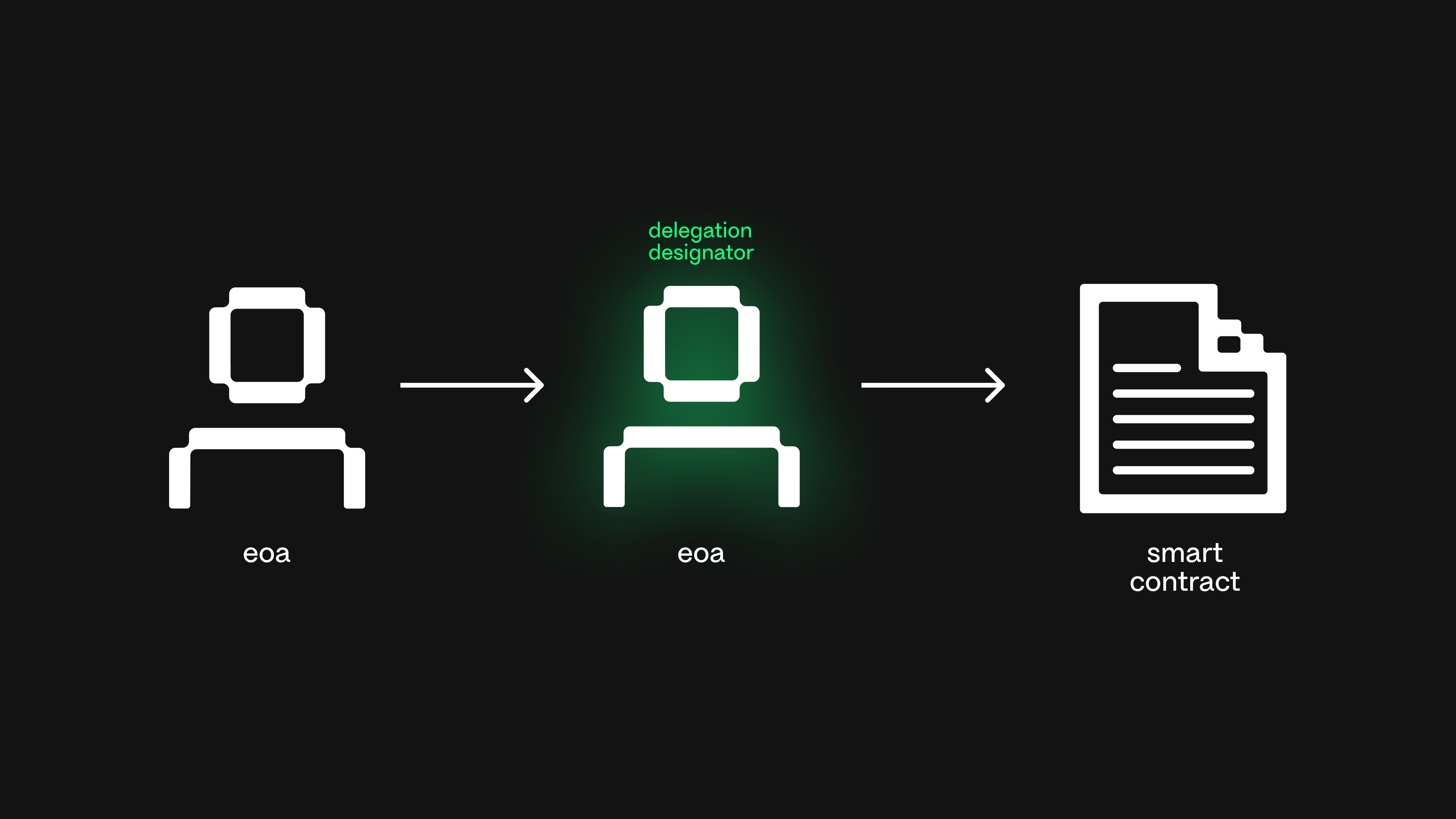
The user's wallet constructs an authorization tuple specifying the target smart wallet address and a unique nonce. This nonce prevents replay attacks, ensuring the same authorization cannot be reused indefinitely.
The EOA signs the authorization tuple. This step is critical because it links the EOA's existing private key to the smart contract's logic, effectively authorizing the contract to act on the EOA's behalf.
The signed authorization is included in a Type 4 transaction. When the Ethereum Virtual Machine (EVM) processes this transaction, it temporarily injects the smart contract's bytecode into the EOA's execution context.
The delegation remains active only for the duration specified by the EIP. Once the transaction completes, the EOA returns to its default state. The user can revoke the delegation at any time by sending a transaction with a higher nonce.
This structure allows EOAs to "borrow" smart wallet capabilities like multi-signature requirements, session keys, or social recovery without the complexity of deploying a new contract. The primary keyword cluster, EIP-7702 migration, refers to this protocol-level capability rather than a user-initiated account migration.
EIP-7702 vs. ERC-4337: Native vs. Layer-2 Account Abstraction
The two primary paths for account abstraction on Ethereum differ fundamentally in architecture. EIP-7702 upgrades the base layer protocol to allow Externally Owned Accounts (EOAs) to temporarily act like smart contracts. ERC-4337 operates as a layer-2 standard, relying on a separate network of bundlers and paymasters to process transactions.
EIP-7702 integrates directly into the Ethereum Virtual Machine (EVM). It allows users to keep their existing EOAs without requiring migration, asset transfers, or address changes. This native approach eliminates reliance on off-chain infrastructure, reducing complexity and potential failure points. In contrast, ERC-4337 requires a distinct transaction lifecycle managed by external actors, which can introduce latency and additional costs.
While EIP-7702 enhances the capabilities of existing addresses, ERC-4337 enables fully decentralized smart contract wallets from the ground up. The two are complementary rather than mutually exclusive. EIP-7702 provides immediate usability for the vast majority of users who prefer simple key management, while ERC-4337 offers robust features for complex, multi-party interactions.
| Feature | EIP-7702 | ERC-4337 |
|---|---|---|
| Architecture | Native EVM upgrade | Layer-2 standard |
| Infrastructure | On-chain only | Off-chain bundlers |
| User Migration | No migration required | New wallet addresses |
| Transaction Type | Signed EOAs | UserOperations |
| Security Model | Temporary delegation | Persistent contract |
The choice between these paths depends on the specific use case. For general users and simple transactions, EIP-7702 offers a seamless upgrade path with minimal friction. For applications requiring complex logic, social recovery, or sponsored transactions, ERC-4337 remains the more flexible solution. Understanding these distinctions is critical for developers and users navigating the evolving landscape of Ethereum account abstraction.
Wallet and dApp integration steps
Supporting EIP-7702 requires wallet providers and decentralized applications to update their signature verification logic. This protocol capability allows externally owned accounts (EOAs) to temporarily adopt smart contract logic, but it does not automatically migrate user funds or change account ownership. Developers must implement specific checks to recognize and validate the new EIP-7702 signature type alongside existing ECDSA signatures.
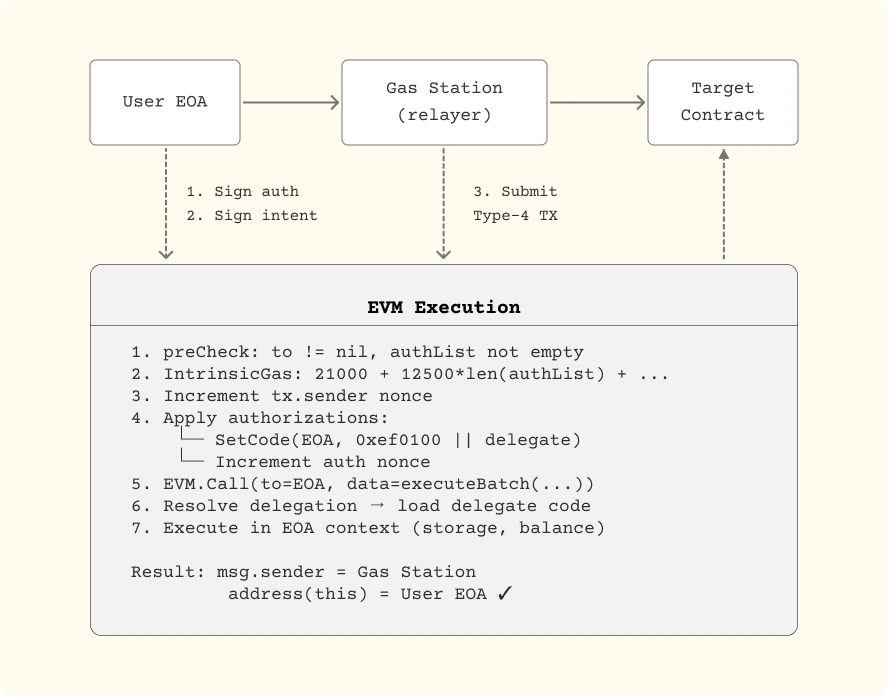
Wallets must integrate libraries that can parse and verify the new EIP-7702 signature format. This involves checking for the specific signature type byte and validating the delegation authorization against the account’s code slot. Without this update, transactions signed with the new type will be rejected as invalid.
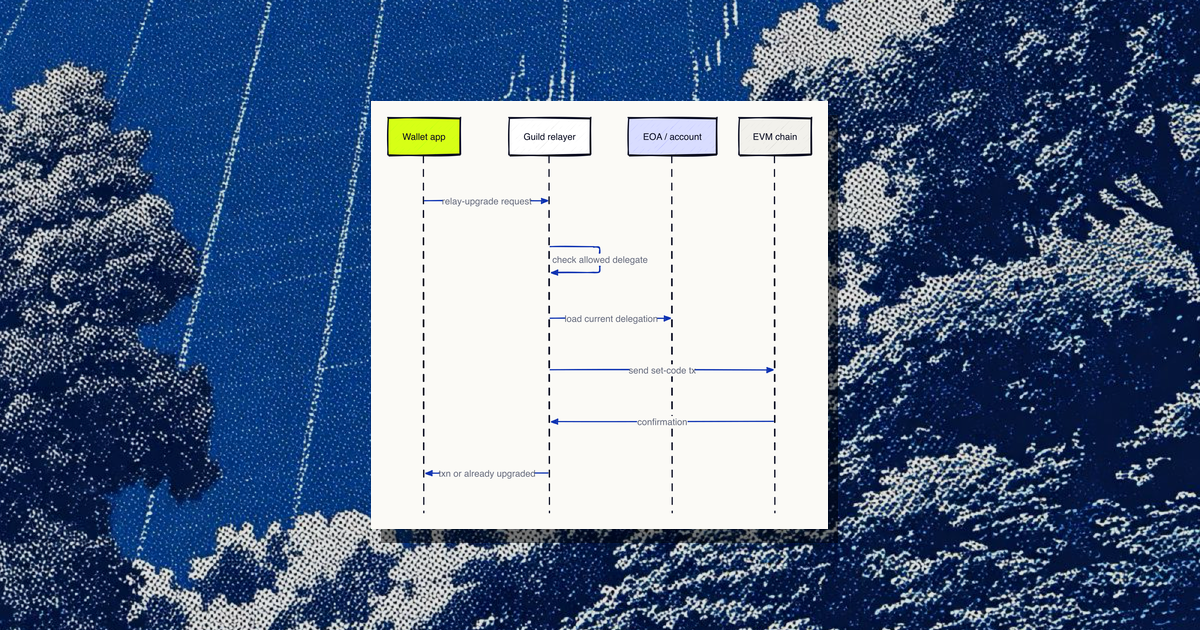
Before executing transactions, wallets should verify whether an EOA has delegated its execution to a smart contract. This requires reading the account’s code slot to identify the authorized contract address. dApps must also account for this delegation status to ensure they are interacting with the correct logic layer.
Transactions involving delegated EOAs may have different gas costs and execution paths compared to standard EOAs. Wallet providers need to update their simulation engines to accurately predict gas usage and potential failures when interacting with delegated accounts. This prevents user errors and failed transactions.
The integration process focuses on technical compatibility rather than user migration. Users do not need to manually transfer funds or change their accounts. Instead, wallet and dApp developers must ensure their infrastructure can recognize and process the new signature types and delegation states defined in the EIP.
| Component | Required Action | Priority |
|---|---|---|
| Signature Verification | Add EIP-7702 signature type support | High |
| Transaction Simulation | Update gas estimation for delegated logic | High |
| User Interface | Display delegation status if available | Medium |
Security risks and delegation limits
EIP-7702 introduces a temporary delegation mechanism that allows Externally Owned Accounts (EOAs) to execute smart contract logic. This capability is not a permanent migration of the account type. Instead, it is a protocol-level feature that activates smart wallet behavior only when a specific signature is present in a transaction. Understanding the security implications of this temporary state is critical for managing risk in 2026.
The core risk lies in the revocation process. Unlike smart contract wallets, which can implement complex recovery logic or multi-signature requirements, an EOA relies on the Ethereum protocol’s standard transaction model. To revoke a delegation, the user must send a transaction that clears the delegation code. If the private key is compromised, an attacker can delegate the EOA to a malicious contract and drain funds. The victim must then react quickly to revoke the delegation, a process that is slower and more manual than the account abstraction recovery flows available in native smart wallets.
In addition, the delegation is context-dependent. It applies to the specific transaction or block context where it is invoked, depending on the implementation details of the calling contract. This means that delegation does not grant persistent, unrestricted access to the EOA’s funds across all future interactions. However, if a user delegates to a contract that holds persistent state or interacts with multiple protocols, the attack surface expands. Users must carefully audit the smart contract they are delegating to, as the security of the EOA is now tied to the security of that contract.
The Ethereum Foundation and major wallet providers emphasize that this feature is optional. Users are not forced to adopt smart wallet logic. The decision to delegate should be based on a clear understanding of the trade-offs between convenience and security. For high-value holdings, maintaining a pure EOA or using a fully self-custodied smart wallet with robust recovery mechanisms remains the safer approach.
Is EIP-7702 fully implemented yet?
EIP-7702 is live on the Ethereum mainnet, but its adoption is defined by infrastructure readiness rather than user migration. The activation provides a protocol-level capability for Externally Owned Accounts (EOAs) to temporarily adopt smart contract logic. It does not require users to migrate their wallets or change their addresses.
The distinction between activation and widespread usage is critical. While the consensus layer supports the feature, integration depends on wallet providers, exchanges, and smart contract platforms. As of 2026, major wallets like Safe have enabled support, but broader ecosystem compatibility remains uneven.
Users do not need to take any action to enable EIP-7702 on their EOAs. The upgrade is passive at the protocol level. However, to utilize the features—such as paying gas in ERC-20 tokens or enforcing session keys—users must interact with compatible frontends. Until those interfaces fully support the new signature types, the feature remains largely dormant for the average user.
| Feature | Status | Dependency |
|---|---|---|
| Protocol Activation | Live on Mainnet | None |
| Wallet Support | Partial | Wallet Provider Updates |
| dApp Integration | Limited | Frontend Compatibility |
The primary constraint is not the protocol, but the tooling. Until wallet interfaces and smart contract platforms uniformly support EIP-7702 signatures, the feature serves as a backend capability rather than a front-facing user experience. The migration is invisible; the adoption is gradual.
No comments yet. Be the first to share your thoughts!